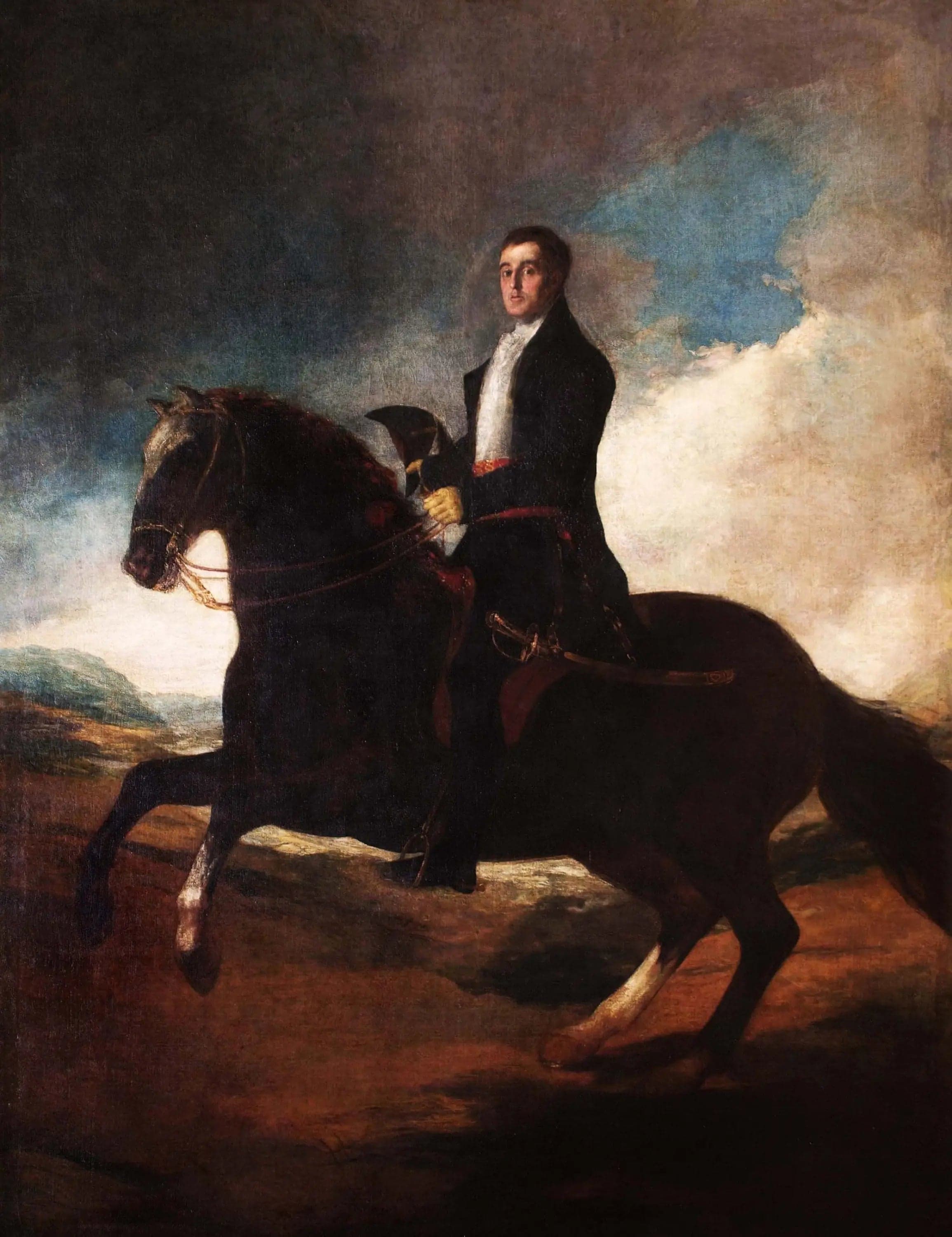
Equestrian Portrait of the 1st Duke of Wellington
- Original dimensions
- 241 x 294 cm
- Movement
- Rococo painting
- Museum
- Apsley House
- Year
- 1812
Scene depicted
The painting depicts the Duke of Wellington, hero of the Battle of Waterloo, with a noble and determined gesture. Balancing between power and majesty, this equestrian representation transforms into a visual statement of British leadership, illustrating not only a man but a nation. The proud gaze of the duke, interacting with the soft light that caresses his face, evokes the pinnacle of an era of conquest and fame.
Historical context
Created in 1812, during a tumultuous period of European history in London, this painting illustrates the power and prestige of the 1st Duke of Wellington. Rooted in the Rococo movement, this painting of impressive scale, currently displayed at Apsley House, immerses us in an era where nobility had to be celebrated through rich and symbolic art. The precious canvas spans 241 x 294 cm, offering us a majestic view of its subject.
Place in the artist's career
This painting occupies a central place in Goya's evolution, marking the peak of his style where classical rigor and romantic sensitivity intertwine. In parallel, works like “La Maja Desnuda” and “The Executions of May 3” show the evolution of his artistic approach, his ability to capture not only the appearance but also the human soul.
Anecdote
Francisco de Goya , known for his artistic sensitivity, once said: “Art is the voice of souls resonating in silence.” Imagine him, sitting in his studio, inspired by the soft light of a spring morning, emotionally capturing the impressive silhouette of the duke on his steed. This pictorial work thus becomes the symbol of a legacy etched in collective memory.