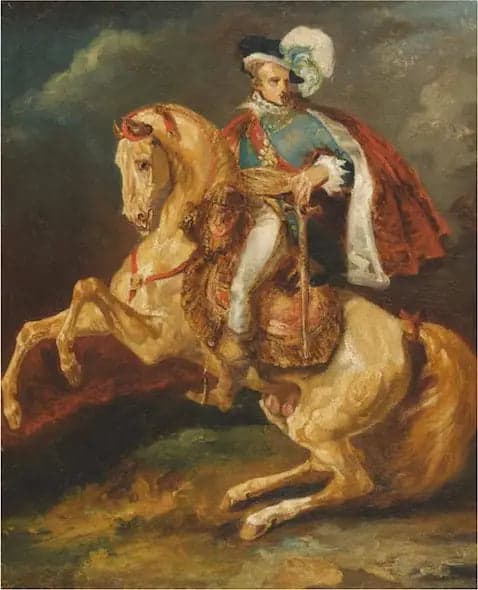
Equestrian Portrait of His Majesty the King of Westphalia, Jérôme Bonaparte
- Original dimensions
- 38 x 48 cm
- Museum
- reserves of the Louvre Museum
- Year
- 1813
Scene depicted
This canvas illustrates the majesty of King Jérôme Bonaparte, in full parade, head held high, one hand on the pommel of his saddle. Géricault, through his talent, manages to capture both the strength and delicacy of his subject, showing how art can celebrate royalty while maintaining a human depth.
Historical context
Created in 1813 in Paris, this painting is part of the romantic movement, reflecting both the military spirit of its time and admiration for monarchical grandeur. Through this canvas , Géricault depicts Jérôme Bonaparte, King of Westphalia, elevating equestrian elegance to an almost mythological level. Today, this masterpiece rests in the reserves of the Louvre Museum , a true sanctuary of art.
Place in the artist's career
The Equestrian Portrait of His Majesty the King of Westphalia represents a turning point in Géricault's career, marking a period of great creativity. Alongside other works such as The Raft of the Medusa and The Offering to the Sea, this canvas testifies to the refinement of his romantic style, combining emotion and technique.
Anecdote
Théodore Géricault once declared, "Art is the truth revealed to those who have the eyes to see it." This quote, inspired by a misty morning when he observed a majestic rider, gives meaning to his masterpiece . The emotion conveyed by the canvas is the result of authentic inspiration, rooted in history and admiration for a king.