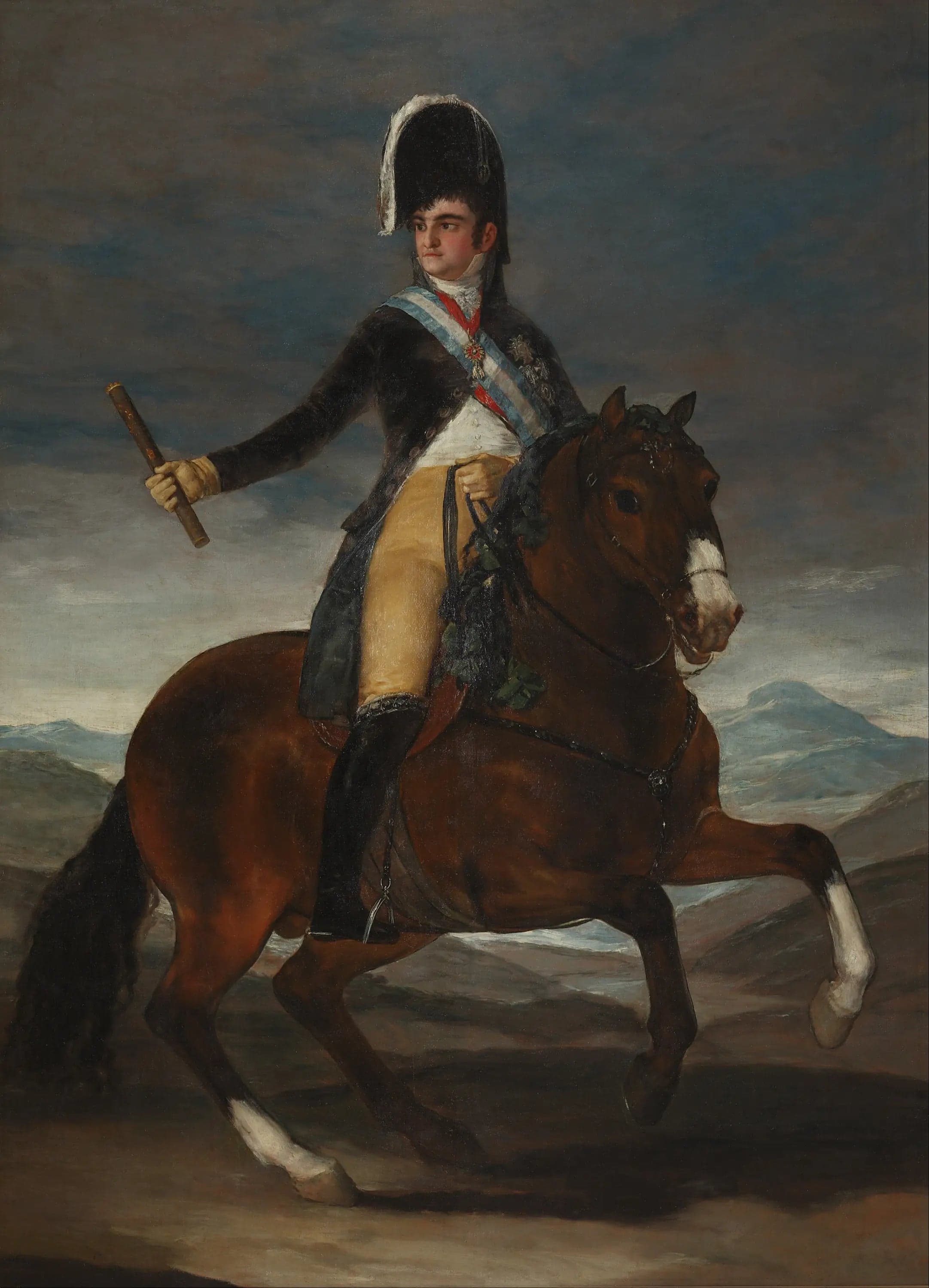
Equestrian Portrait of Ferdinand VII
- Original dimensions
- 205 x 285 cm
- Museum
- Royal Academy of Fine Arts of Saint Ferdinand
- Year
- 1808
Scene depicted
This canvas depicts Ferdinand VII, King of Spain, in a majestic equestrian pose, dressed in splendid ceremonial attire. Goya's art highlights not only the king but also the symbols of power and nobility that surround the scene. Ferdinand's confident posture and determined gaze give the sick a sense of dignity and strength, while embodying the spirit of Spain during that era.
Historical context
Created in 1808, in the heart of Madrid, this painting is emblematic of the romantic movement, a pivotal period between neoclassicism and more liberal artistic expressions. In a tumultuous historical context, marked by the repercussions of the Spanish War of Independence, the canvas symbolizes the majesty and power of a king during a time of turbulence. Today, this masterpiece proudly resides at the Royal Academy of Fine Arts of Saint Ferdinand, where it continues to dazzle visitors with its impressive dimensions.
Place in the artist's career
The Portrait of Ferdinand VII on Horseback is one of the stylistic peaks of Goya's career, representing a period when his style became more assertive. Compared to other works such as "The Family of Charles IV" and "The 3rd of May 1808," this masterpiece illustrates the artist's evolution, both technically and emotionally. Each canvas reveals a particular face of Spain, and together they paint a picture of tensions, pride, and humanity.
Anecdote
It is said that Goya was inspired by the tenacity of a spring morning, when the light caressed the sand and grasses of Madrid, revealing the haunting beauty of his country. "In every portrait, I try to capture the soul that hides behind the face," he would have confided one day. This quest for the soul is found in every brushstroke of the canvas , inviting the viewer to feel not only the grandeur of Ferdinand VII but also the complexity of his time.