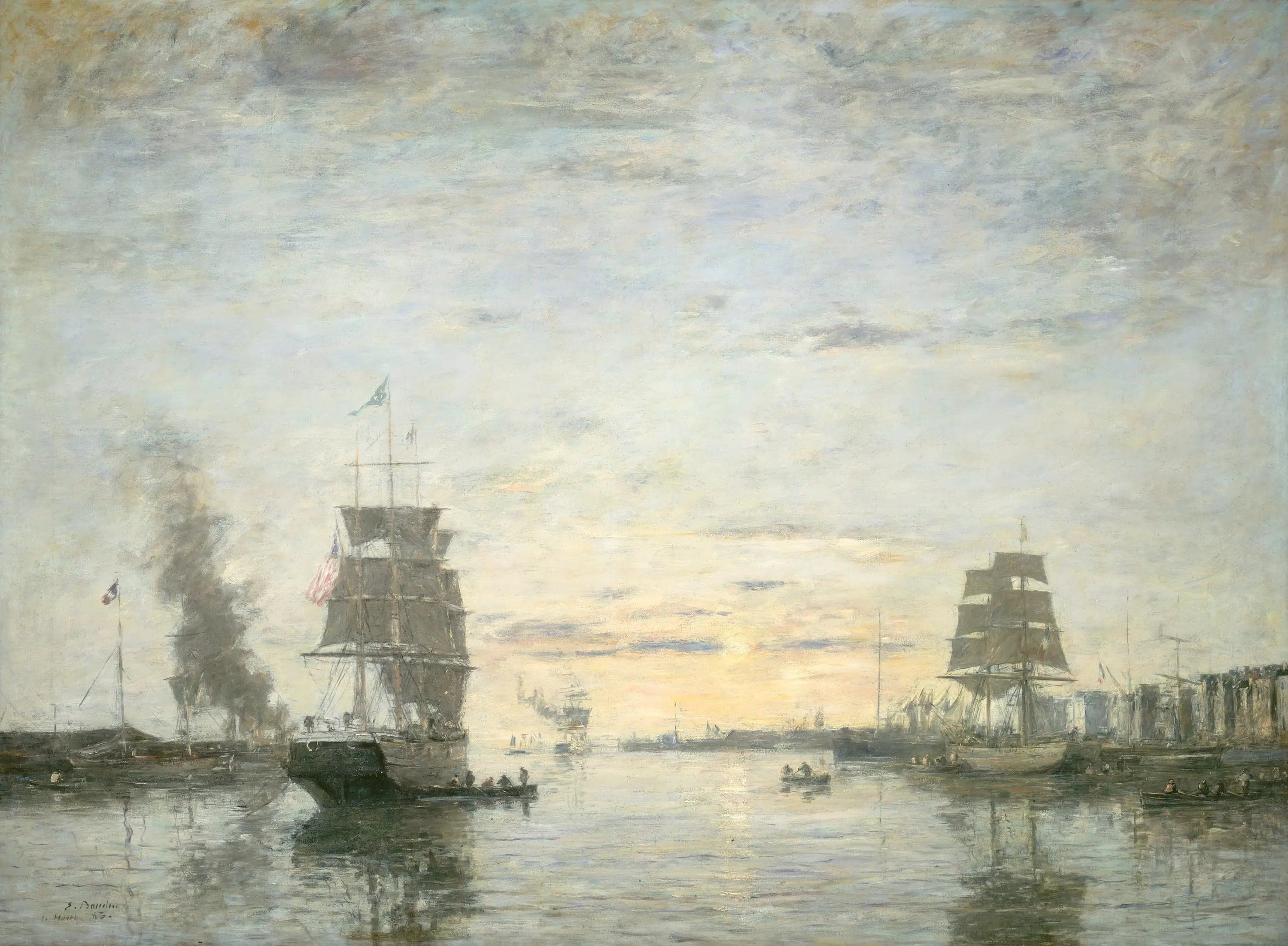
Entrance to the Port of Le Havre
- Original dimensions
- 160.2 x 118.6 cm
- Museum
- National Gallery of Art
- Year
- 1883
Scene depicted
The canvas "Entry of the Port of Le Havre" depicts a striking view of the port, where majestic sailboats glide under a cloudy sky. The boats, dressed in white sails, seem to dance on the waves, while the silhouettes of the docks recall the bustle of active maritime traffic. The bright light refracted on the water plays with the hues, adding a specific dynamic to this essential pictorial work.
Historical context
Created in 1883, the painting "Entry of the Port of Le Havre" is at the heart of Impressionism , an artistic movement that celebrates light and nature. This canvas is an iconic representation of the port of Le Havre, a maritime city rich in history, located in Normandy. Currently on display at the National Gallery of Art , this work evokes nostalgia for a time when maritime trade was thriving, with majestic dimensions that captivate anyone who crosses its path.
Place in the artist's career
This canvas , one of the first to fully embody Boudin's immersion in the Impressionist technique, represents both a stylistic peak and a turning point in his career. Like works such as "The Beach at Trouville" and "The Landing of the King of Prussia," this painting establishes a continuity in his artistic expression, marking a transition to brighter light and bolder compositions.
Anecdote
“Every shore, every wave, is an ode to the beauty of our world.” These words, though fictional, capture the spirit of the artist. Inspired one foggy morning, as the light caresses the surface of the water, Boudin captured the essence of the sea and the port of Le Havre. This painting evokes not only the maritime scene but also the melody of the floating sails and the scent of the salty air, creating a deep connection with nature.