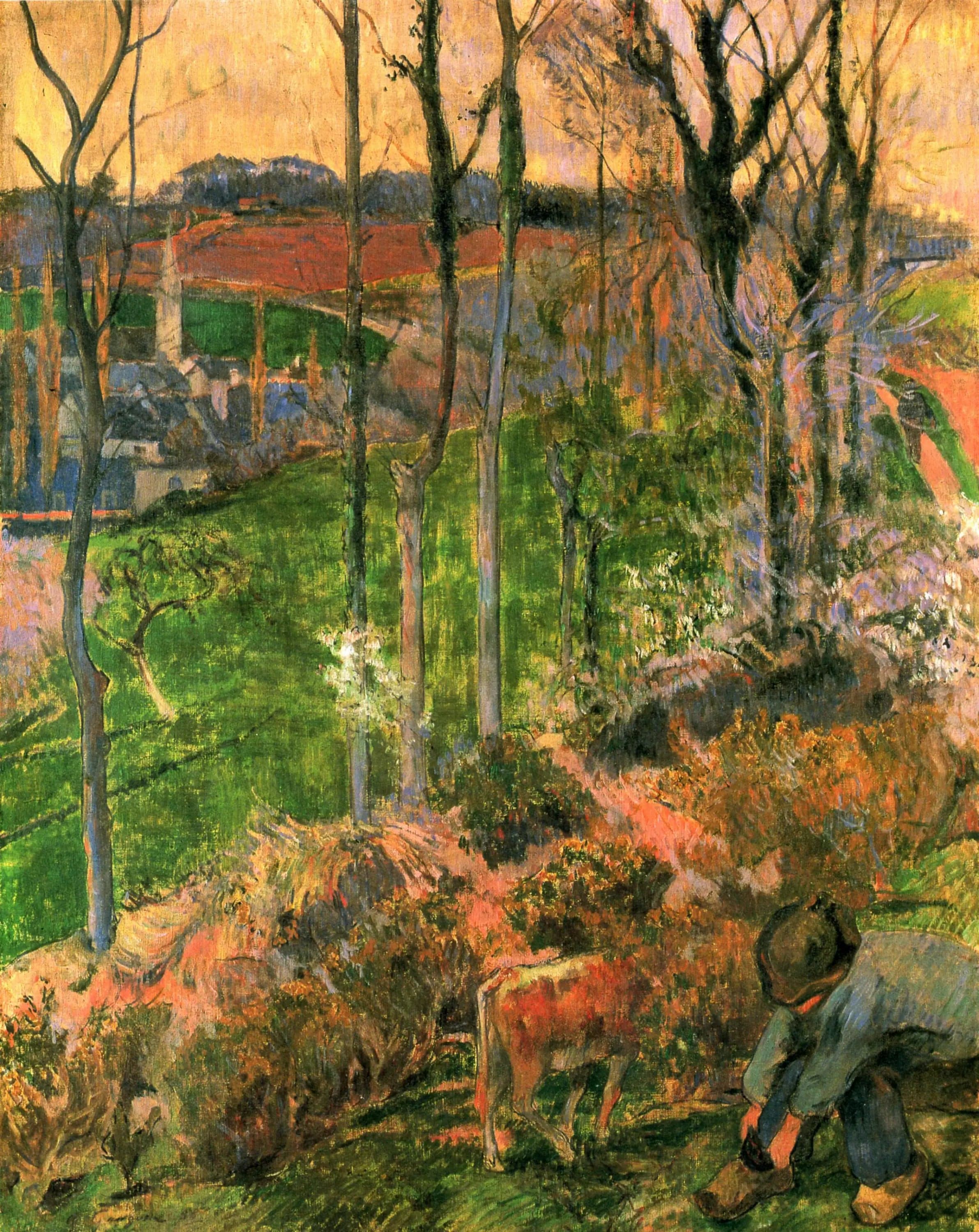
End of Winter in Pont-Aven, Breton and Calf; or Little Breton Arranging His Clog
- Original dimensions
- 71 x 90.5 cm
- Museum
- Ny Carlsberg Glyptotek
- Year
- 1888
Scene depicted
This painting depicts a young Breton, sitting by the side of a road, absorbed in caring for his hoof, while a calf beside him adds a touch of life to the scene. The warm colors and rounded shapes evoke a peaceful and rural daily life, where the child interacts with the nature surrounding him. The composition stands as an ode to the simplicity of country life.
Historical context
This painting , created in 1888, takes its roots in Pont-Aven, a village in Brittany, famous for being the cradle of the post-impressionist movement. The canvas, inhabited by a soft and melancholic light, perfectly illustrates the era marked by social and cultural transformations. Today, this painting is preserved at the Ny Carlsberg Glyptotek , a true sanctuary for this pictorial heritage of the late 19th century.
Place in the artist's career
Fin d'hiver à Pont-Aven positions itself as a turning point in Gauguin's career, marking a period of stylistic exploration. This painting, at the crossroads of several influences, resonates in his other works, such as Vision after the Sermon and The Yellow Christ , reflecting a marked evolution towards colorful and emotional abstraction, typical of post-impressionism .
Anecdote
In a burst of creativity, Gauguin once declared: "Art must move, arise from the heart to touch that of others." One spring morning, he walks through the alleys of Pont-Aven, letting his gaze rest on a Breton child, absorbed in his work. It is this scene, filled with simplicity and sincerity, that will inspire the masterpiece that this painting represents.