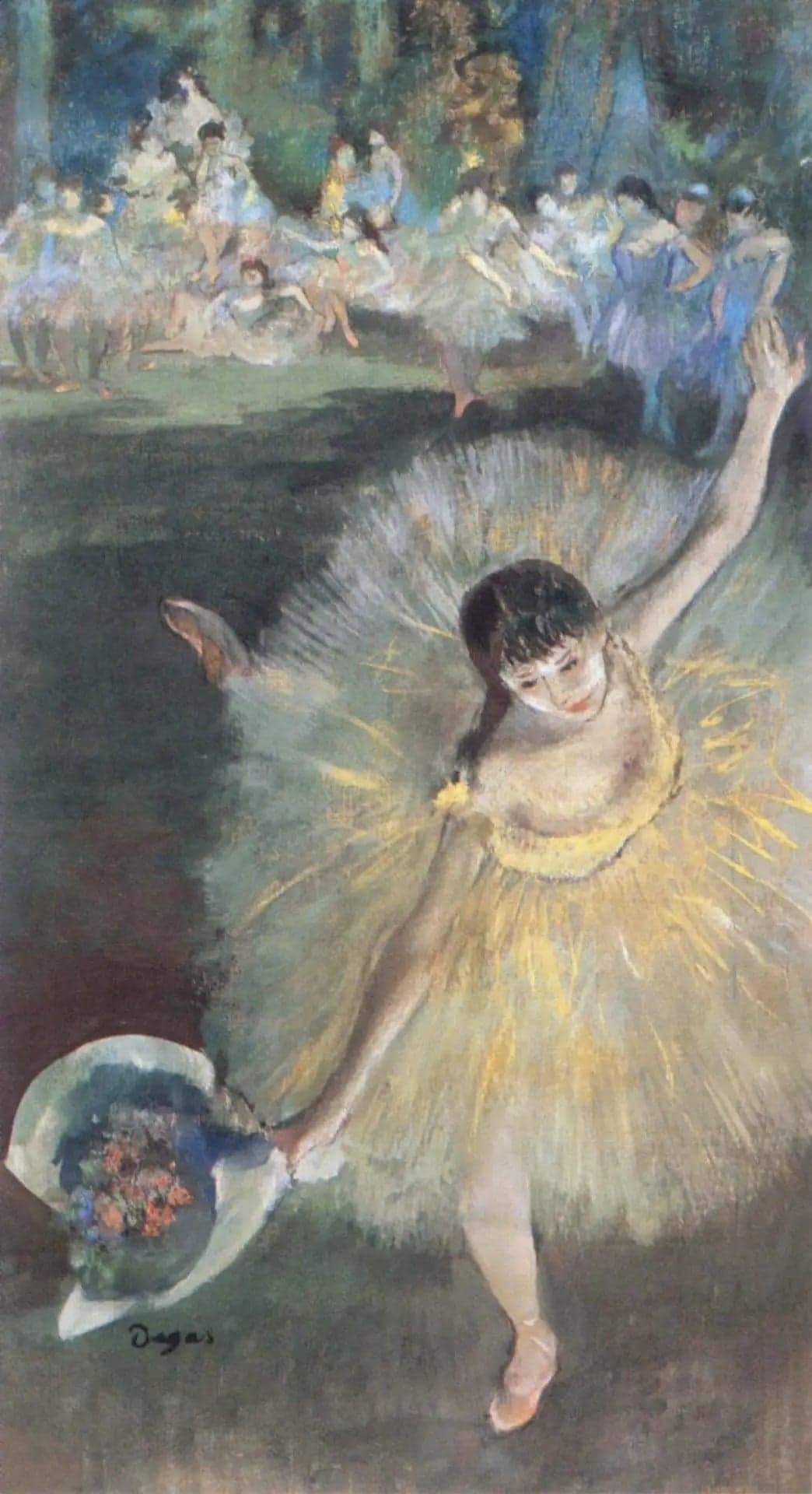
End of the Arabesque
- Original dimensions
- 38 x 67.4 cm
- Museum
- musée d'Orsay
- Year
- 1876
Scene depicted
“Fin d'arabesque” depicts a ballerina in full motion, her body curved in the elegance of an arabesque. The painting, through its composition and dynamics, invites one to feel the ephemeral beauty of dance. The eye is guided through the harmony of shapes and colors that blend to bring to life a striking artistic performance.
Historical context
Created in Paris, France, at the end of the 19th century, the painting "Fin d'arabesque" is part of the impressionist movement. At a time when art was evolving towards capturing light and movement, this canvas stands out not only for its subject but also for the bold technique of Edgar Degas . Currently exhibited at the musée d'Orsay , this painting measures 38 by 67.4 cm.
Place in the artist's career
In the career of Edgar Degas , “Fin d'arabesque” is at a fascinating crossroads: both a promising beginning and a stylistic peak. By contrasting it with other works such as “La Danseuse à la rose” and “Les Danseuses bleues,” one can observe the evolution of his technical and emotional mastery, moving towards a deeper exploration of the human condition and the art of movement.
Anecdote
“Every masterpiece must resonate like a dance.” This could have been one of Edgar Degas 's words, evoking his inspiration, born from a sunrise over ballet scenes. In this fleeting moment, a scent of the artistic scene and a whisper of light footsteps led him to immortalize the graceful movement of his ballerinas, capturing the very spirit of the painting .
Major exhibitions
third impressionist exhibition