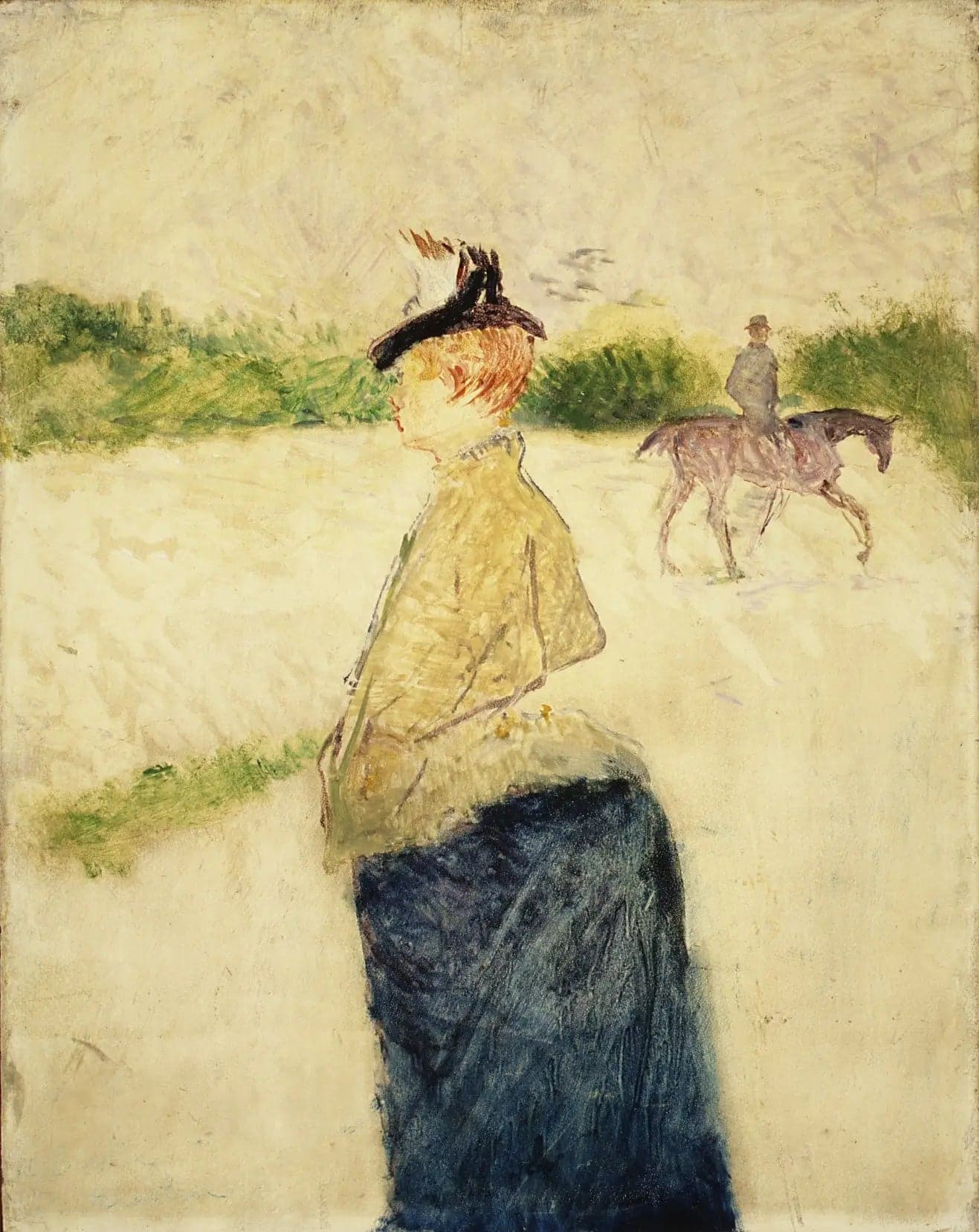
Émilie - Henri de Toulouse
- Original dimensions
- 32.4 x 41.3 cm
- Museum
- Metropolitan Museum of Art
- Year
- 1890
Scene depicted
In the painting Émilie, Toulouse-Lautrec magnificently captures the fleeting essence of a dancer in full act. She stands there, her agile body seeming to dance with the play of light and shadow, as a discreet homage to the magic of Parisian shows. This painting illustrates not only his subjectivity but also his talent for immortalizing moments of life, infusing a vibrant emotion into this canvas .
Historical context
Created in 1890, the painting Émilie is set in the vibrant backdrop of Montmartre, Paris, the cradle of the Impressionist and Post-Impressionist artistic movement. At a time when the French capital is in full cultural effervescence, this painting stands out as a true ode to beauty and the expression of an era. Currently exhibited at the Metropolitan Museum of Art in New York, this magnificent canvas offers a window into a romantic and dynamic Paris.
Place in the artist's career
Émilie represents an important milestone in Toulouse-Lautrec's career, marking the transition to recognized artistic maturity. It is part of a period where he explores various techniques, between vibrant portraits like La Goulue, and the famous painting of La Moulin Rouge. This masterpiece testifies to his evolution, between realism and a touch of personal expression, thus cultivating his unique style.
Anecdote
Henri de Toulouse-Lautrec reportedly said: "I seek to capture the soul of the characters who pass through my field of vision." One spring morning, lost in the soft light of Montmartre, he spots Émilie, a dancer with enchanting charm, who inspires this pictorial work . The evocative power of this moment is found in every brushstroke of the painting.