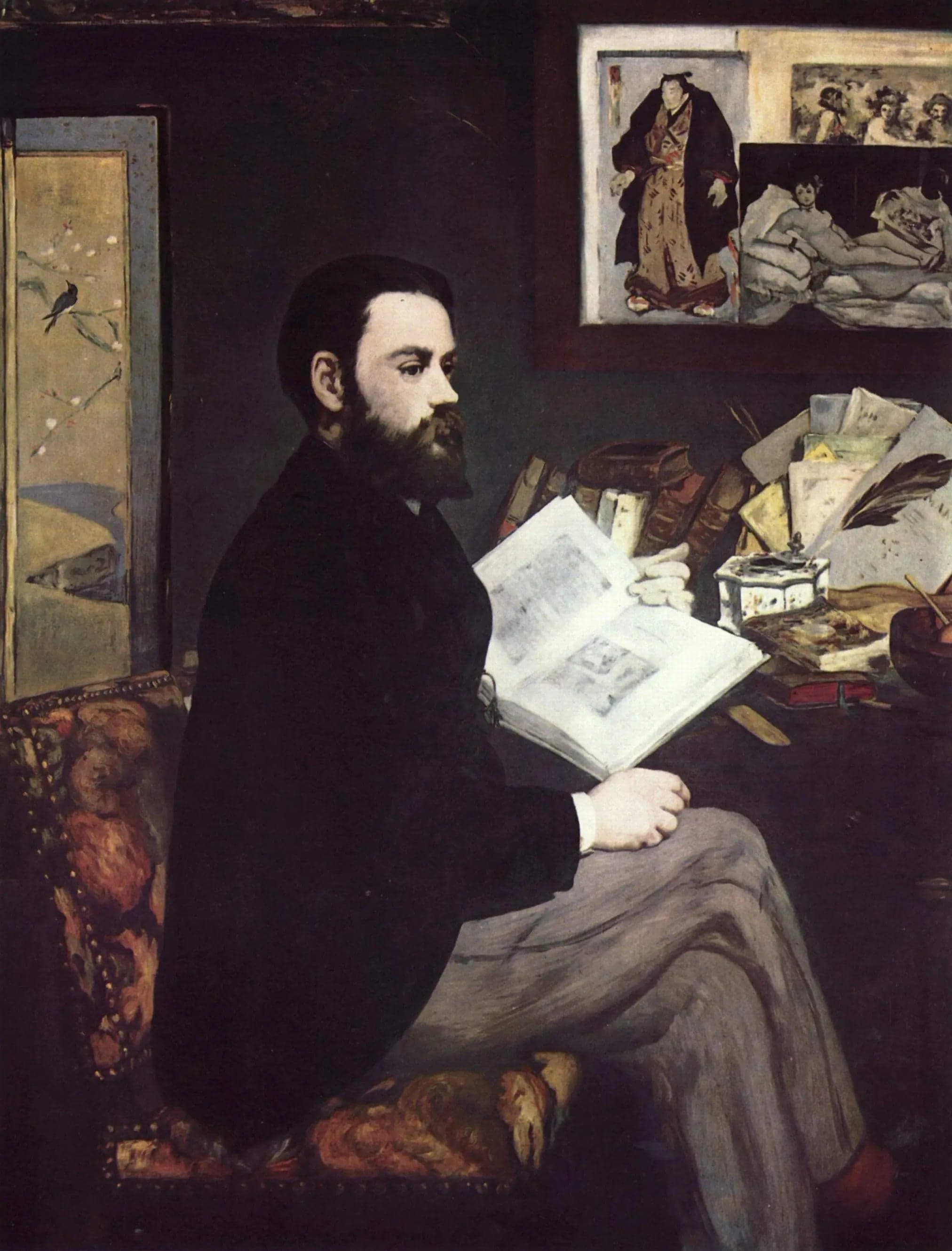
Émile Zola
- Original dimensions
- 114 x 146.5 cm
- Museum
- musée d'Orsay
- Year
- 1868
Scene depicted
The painting “Émile Zola” immortalizes the intellectual surrounded by books and paperwork, in an introspective pose. This painting illustrates not only the man of letters but also represents an era where literature and art intertwine, embodying the struggle for a better society. The meticulous composition reveals a deep admiration from Manet for his model, but also an underlying critique of the morals of his time.
Historical context
Created in 1868, the painting titled “Émile Zola” unfolds in the vibrant context of the late 19th century in Paris, the capital of the Impressionist movement. This painting is set in a time when art claims a new voice, far from academic conventions. Today, this iconic painting is preserved at the musée d'Orsay, a sanctuary dedicated to the treasures of French art.
Place in the artist's career
This painting , at the crossroads of Manet's career, represents a period of artistic maturity. In parallel with “Le Déjeuner sur l'herbe” and “Olympia”, “Émile Zola” shows the evolution of his style towards a more intimate and psychological approach, blending boldness and respect for his subjects.
Anecdote
“The truth of a man is his passion” could have been said by Manet when talking about the genesis of his masterpiece . One sunny morning, while walking the Parisian boulevards, he crossed paths with the piercing gaze of Émile Zola, an emblematic writer. This encounter etched itself in his memory, infusing a vibrant energy into his canvas , which he painted with remarkable intensity.
Major exhibitions
Salon de 1868