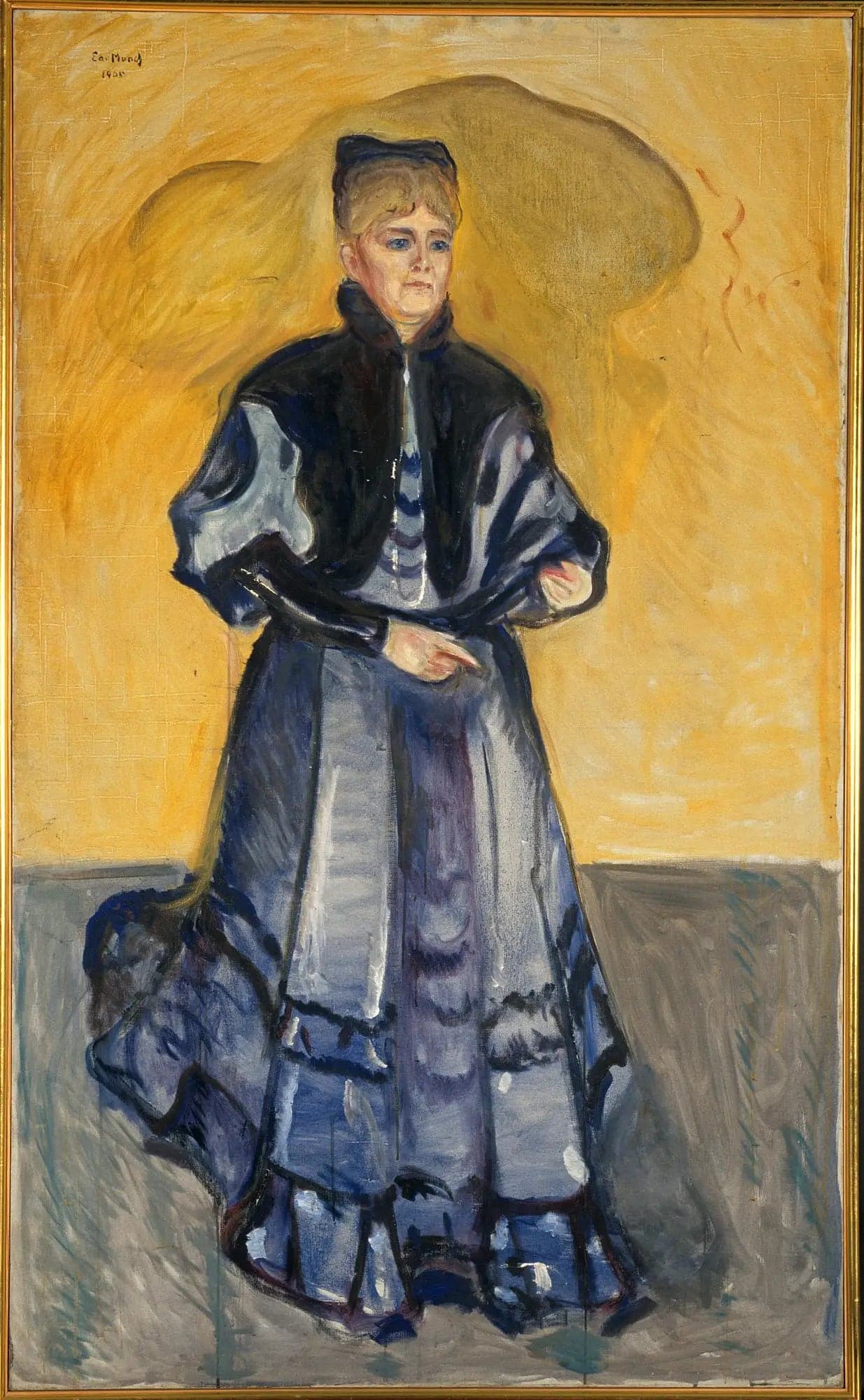
Elisabeth Förster-Nietzsche
- Original dimensions
- 80 x 115 cm
- Museum
- Thiel Gallery
- Year
- 1906
Scene depicted
The painting "Élisabeth Förster-Nietzsche" captures an intimate and poignant moment. At the center of the composition, Élisabeth, sister of the philosopher Friedrich Nietzsche, is depicted in a state of contemplation, marine, immersed in her thoughts. Munch, with a deep gaze, manages to convey an atmosphere that is both melancholic and comforting, illustrating the duality of human emotions in the face of life's torments.
Historical context
Created in 1906 in the heart of the city of Stockholm, this painting is emblematic of the expressionist movement, where Munch explores the depths of the human soul. At that time, art takes a bold turn, and the canvas you are contemplating represents a moment of unique emotional vulnerability. This masterpiece is currently exhibited at the Thiel Gallery, a prestigious venue dedicated to modern and contemporary art, where it resides under the watchful eye of art lovers.
Place in the artist's career
This canvas is part of a pivotal period in Munch's career, where he juggles between psychological exploration and the expansion of artistic sensibilities. At that time, he also brings to life other great pictorial works , such as "The Scream" and "The Madonna," reflecting a growing technical development and emotional intensity in his creations.
Anecdote
Munch once stated: "Art must be a way of life; a rarification of life, but more intense." Imagine him, in front of an autumn landscape, observing the vibrant colors and shadows dancing in the wind. It is in this setting that the evocative power of Élisabeth Förster-Nietzsche was born, a canvas filled with feelings, introspection, and personal resonance.