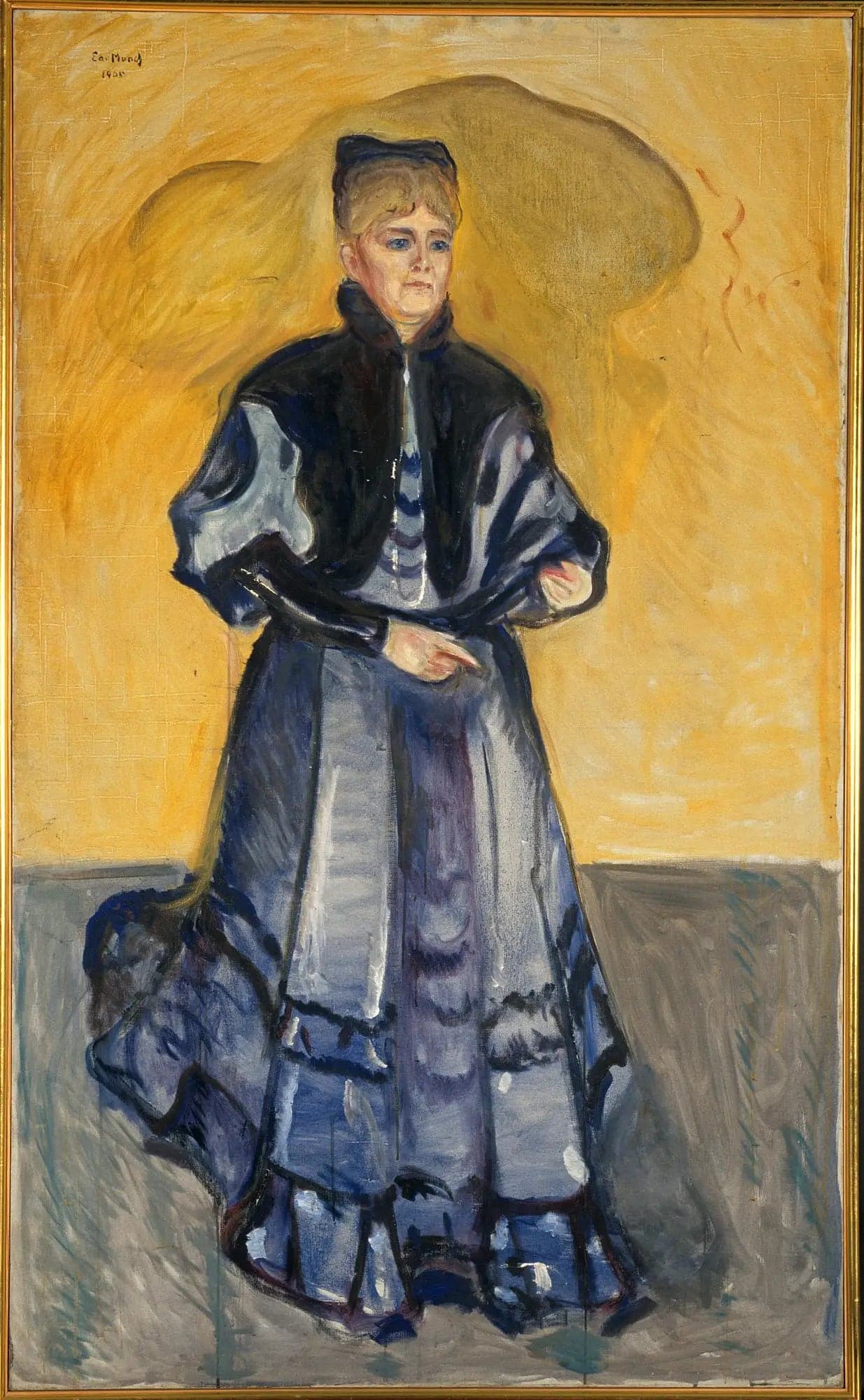
Elisabeth Förster-Nietzsche
- Original dimensions
- 80 x 115 cm
- Museum
- Thiel Gallery
- Year
- 1906
Scene depicted
The painting "Élisabeth Förster-Nietzsche" depicts an emotional portrait where the artist captures the psychological intensity of his model. In this frozen moment, the canvas expresses a melancholic atmosphere, highlighting the haunting beauty of the woman who seems lost in her thoughts, thus revealing the meanders of the human soul. The delicate features and deep nuances combine to stage a universal story of solitude and reflection.
Historical context
Created in 1906, the painting "Élisabeth Förster-Nietzsche" is the result of an intense moment in Scandinavian artistic history. Located in Stockholm, Sweden, this canvas brilliantly illustrates the expressionist movement, a period when Munch explores the meanders of human emotions. Today, this painting is exhibited at the Thiel Gallery, a privileged setting that highlights its artistic radiance and history.
Place in the artist's career
This painting is part of a pivotal period in Munch's career, marked by an elevation of his style and a deeper exploration of human emotions. At this time, he also created iconic works such as "The Dance of Life" and "The Scream," which share a similar sensitivity but are distinguished by diverse narrative elements. "Élisabeth Förster-Nietzsche" thus represents a moment of artistic maturity, where Munch asserts his identity while enriching his visual vocabulary.
Anecdote
Edvard Munch once declared: "True painting is that which is felt in the soul." This quote resonates particularly with the genesis of his work, which captures the essence of a moment of introspection shared with Élisabeth Förster-Nietzsche, a figure who profoundly marked him. The painting was born on a sunny morning when the first rays of spring caressed the walls of the artist's studio, revealing the enigmatic face of his muse and awakening the pure emotion found in this composition .