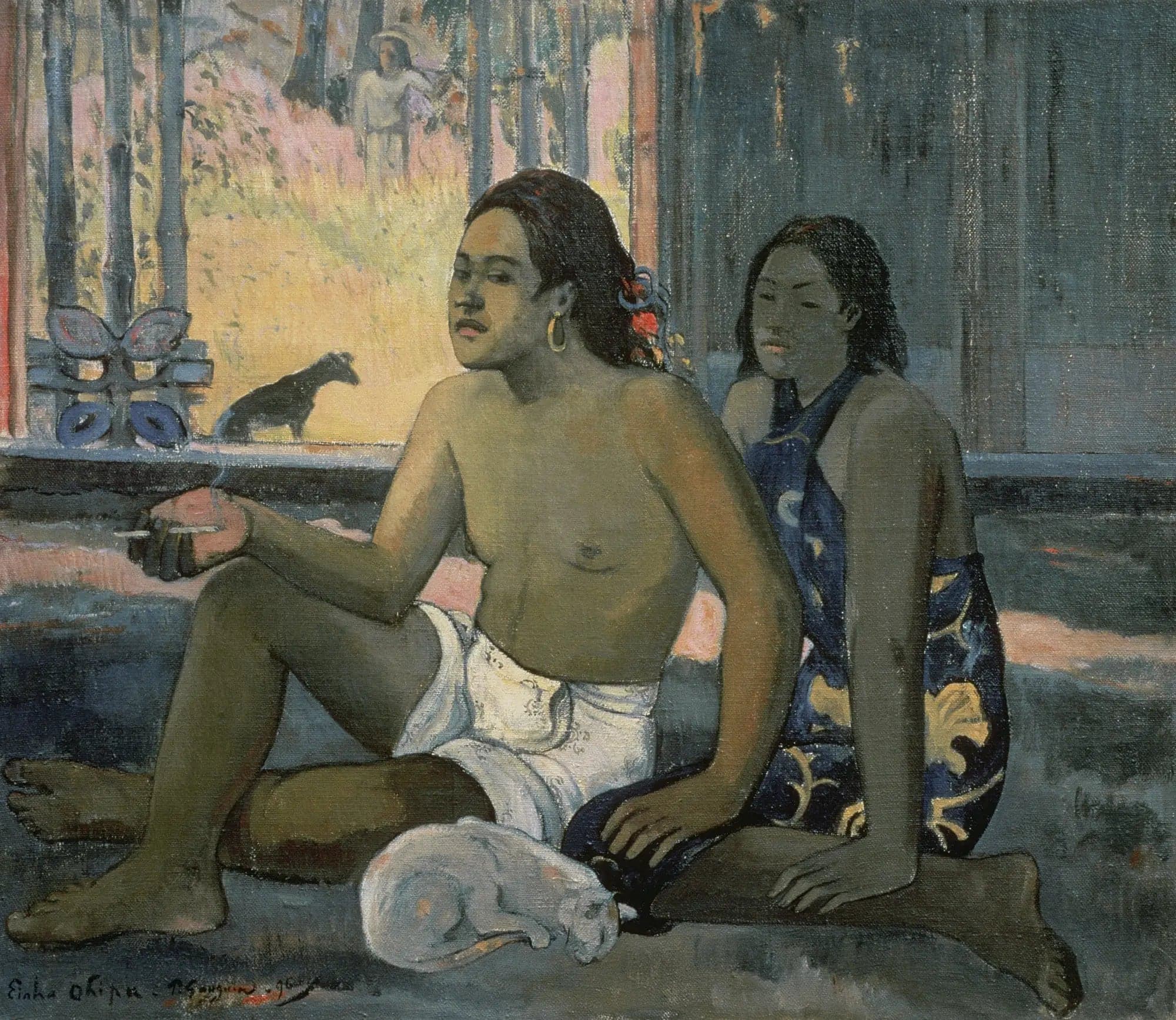
Eiaha Ohipa
- Original dimensions
- 75 x 65 cm
- Museum
- Pushkin Museum of Fine Arts
- Year
- 1896
Scene depicted
This painting delicately illustrates an emblematic interior scene of Polynesian culture. A woman, draped in traditional attire, is depicted at the heart of a characteristic landscape, where light plays on the texture of the surrounding plants. The pictorial work reveals a suspended moment, without artifice, inviting the viewer to a deep contemplation of the everyday. The apparent simplicity hides a richness that is both cultural and personal, inherent to Gauguin's spirit.
Historical context
Created at the end of the 19th century, this painting embodies the visionary spirit of Paul Gauguin , a key player in the post impressionist movement. Witness to a time of upheaval, Eiaha Ohipa was born under the warm sky of Tahiti, an island that would redefine the artist's pictorial universe. Today, the canvas proudly rests at the Pushkin Museum of Fine Arts , attracting an audience eager for unique artistic experiences.
Place in the artist's career
Eiaha Ohipa ranks as a highlight of Gauguin's career. At a time when he is searching for his artistic identity, this painting symbolizes a transition towards a more spiritual and authentic exploration of life. Compared to works such as Vahine no Te Tiare and The Visionary , it denotes a remarkable maturation in his approach to color and form, as well as an increased understanding of the subjects he chooses to represent.
Anecdote
“Color is my wife, she will love me as long as I remain faithful to her” Gauguin might have said while painting Eiaha Ohipa . Imagine a peaceful morning, rocked by the song of tropical birds, where he would have crossed the gaze of a young woman, his muse, inspiring this masterpiece of light. The evocative power of that moment remains alive in the composition of this canvas .