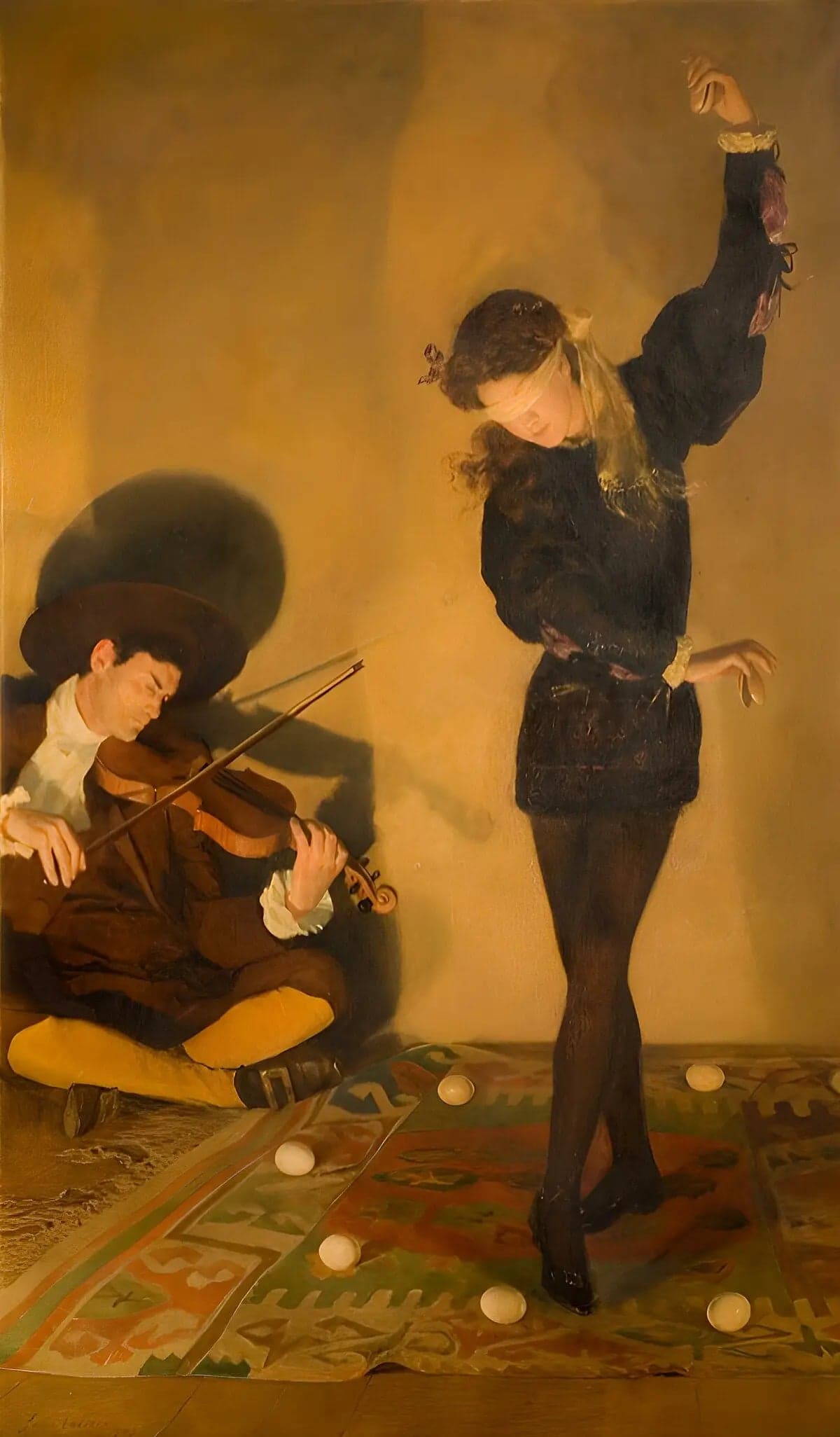
Egg Dance
Scene depicted
"Dance of the Eggs" captures a moment of enchantment, where graceful silhouettes bloom around eggs adorned with delicate patterns. The composition illustrates an imaginary ball, an ode to fertility and rebirth, framed by natural elements that recall the essence of the cycle of life. This painting bears witness to a joyful dance between nature and humanity, revealing the ephemeral beauty of the seasons.
Historical context
Created in 1910, the painting "Dance of the Eggs" finds its roots in London, a vibrant metropolis of the United Kingdom, at the heart of an artistic movement marked by symbolism. This canvas emblematic rises to the rank of a major work of the early 20th century, testifying to the cultural richness and aesthetic concerns of its time. Currently, this masterpiece is preserved in a private collection, and its majestic dimensions remain a mystery, adding to its allure.
Place in the artist's career
This painting , "Dance of the Eggs," is situated at a turning point in John Collier 's career, where his style, already well established, reaches a unique maturity. Echoing his other canvas , "The Denial in Spring," and "The Conversation," this work is characterized by a bold use of natural light and themes related to nature. Collier explores with unparalleled finesse the connection between man and his environment, while linking images and emotions.
Anecdote
As John Collier once mentioned: "The light of the skies on a spring morning illuminates the soul, just as my painting enlightens the mind." Such was the inspiration that animated him in this magical moment, when the sweet scent of flowers floated in the fresh air, creating a soft and melodious atmosphere, a perfect reflection of the canvas .