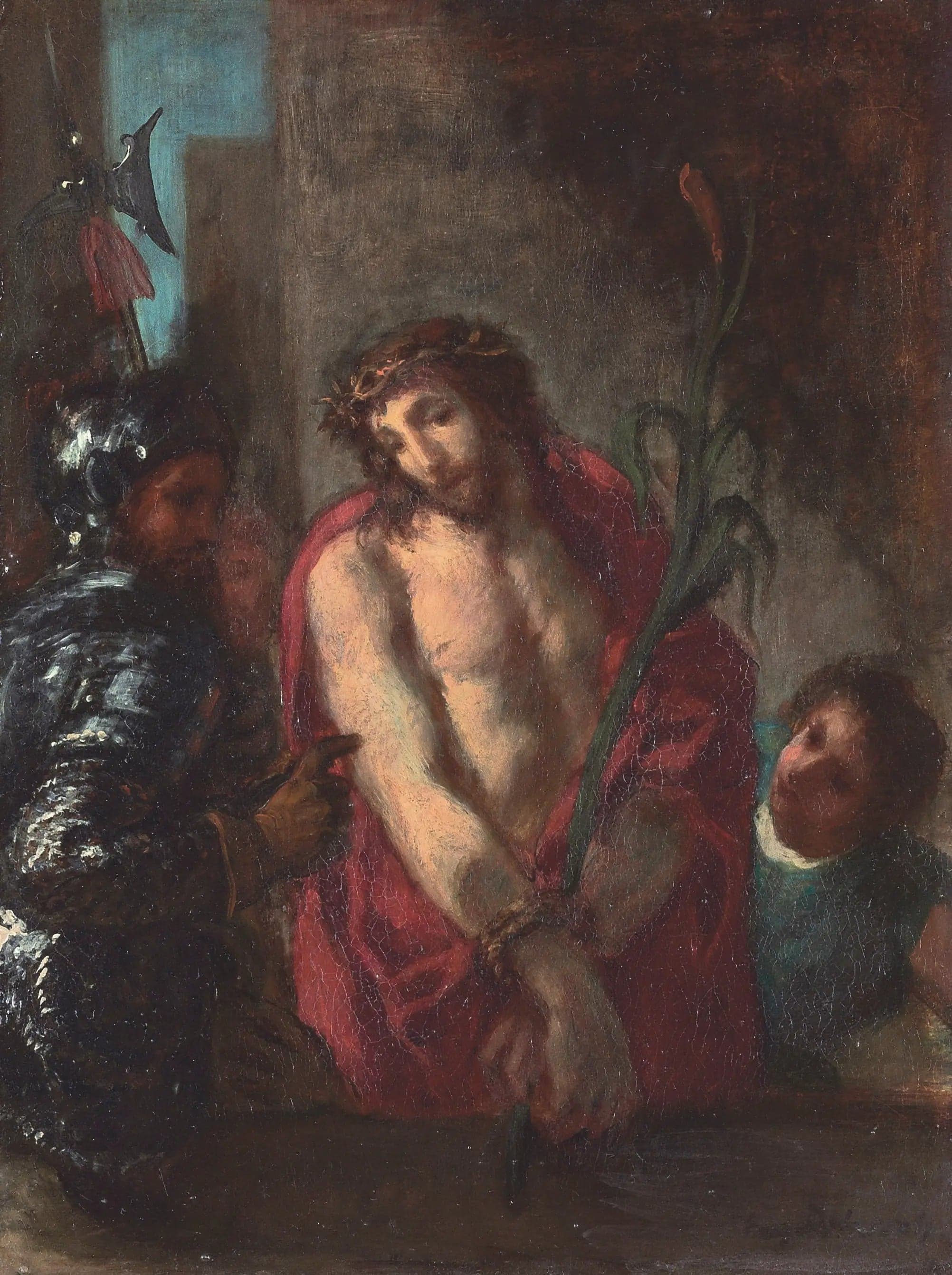
Ecce homo
- Original dimensions
- 24 x 32 cm
- Museum
- Kunsthalle Bremen
- Year
- 1848
Scene depicted
In this canvas , Delacroix illustrates the biblical episode where Pilate presents Christ to the people with the enigmatic phrase "Ecce Homo," marking the tragic irony of the situation. The palpable tension is drawn between the innocence of Jesus, depicted here with an impression of suffering, and the accusatory gaze of the crowd. The play of shadow and light enhances the dramatization, echoing the inner struggles of the soul.
Historical context
Created in 1848 in Paris, this painting is emblematic of the 19th-century Romantic movement. In a time marked by social and political upheaval, Eugène Delacroix delivers an emotional work that transports viewers to the heart of the tensions of his time. Today, this canvas rests at the Kunsthalle Bremen , a museum that celebrates European artistic excellence.
Place in the artist's career
This canvas represents a crucial step in Delacroix's career, where he moves from budding promises to the peak of his genius. After his famous work " Liberty Leading the People ," one can also mention " The Massacre at Chios ," a masterpiece where melancholy and passion meet, revealing the dramatic and stylistic evolution of the artist.
Anecdote
“I seek the truth in forms and colors.” These words resonate like a promise. The inspiration for this masterpiece sprouted at the turn of a Parisian alley when Delacroix crossed paths with a man with a troubled heart. This gaze became the starting point for the painting that would link emotion and action, bringing to life the splendid composition of Ecce homo.