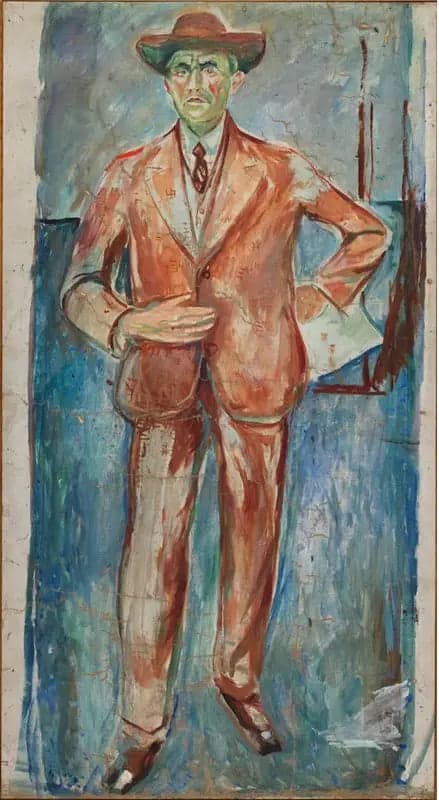
Eberhard Grisebach
- Original dimensions
- 100 x 115.5 cm
- Museum
- Munch Museum
- Year
- 1932
Scene depicted
The painting Eberhard Grisebach illustrates a poignant scene, where human figures intertwine in a dance of vivid and conflicting emotions. Through a complex composition, Munch manages to capture the very essence of anguish and passion, inviting the viewer to explore a visual psychoanalysis of human relationships.
Historical context
Created in 1932, the painting Eberhard Grisebach is located in the vibrant heart of Oslo, Norway. This canvas emanates from the expressionist movement, a time when artists sought to explore deep and personal emotions. This painting is now preserved in the Munch Museum, a sanctuary dedicated to the works of this innovative artist. The imposing dimensions of 100 x 115.5 cm make this work a captivating focal point in any art collection.
Place in the artist's career
This canvas stands at the pinnacle of Munch's career, illustrating his stylistic maturity. By comparing it to two other iconic paintings , such as The Scream and The Madonna , we can observe the evolution of his use of color and form, as well as his ever-growing ability to communicate complex emotions.
Anecdote
Edvard Munch often said: “Art is the disease I suffer from, the echo of my darkest thoughts.” It was during a solitary walk on a gentle spring morning in Oslo that he encountered a face imbued with melancholy, an image that fueled his inspiration for this masterpiece . The emotional strength of Eberhard Grisebach resonates deeply, touching those who contemplate it.
Major exhibitions
Edvard Munch : portretter