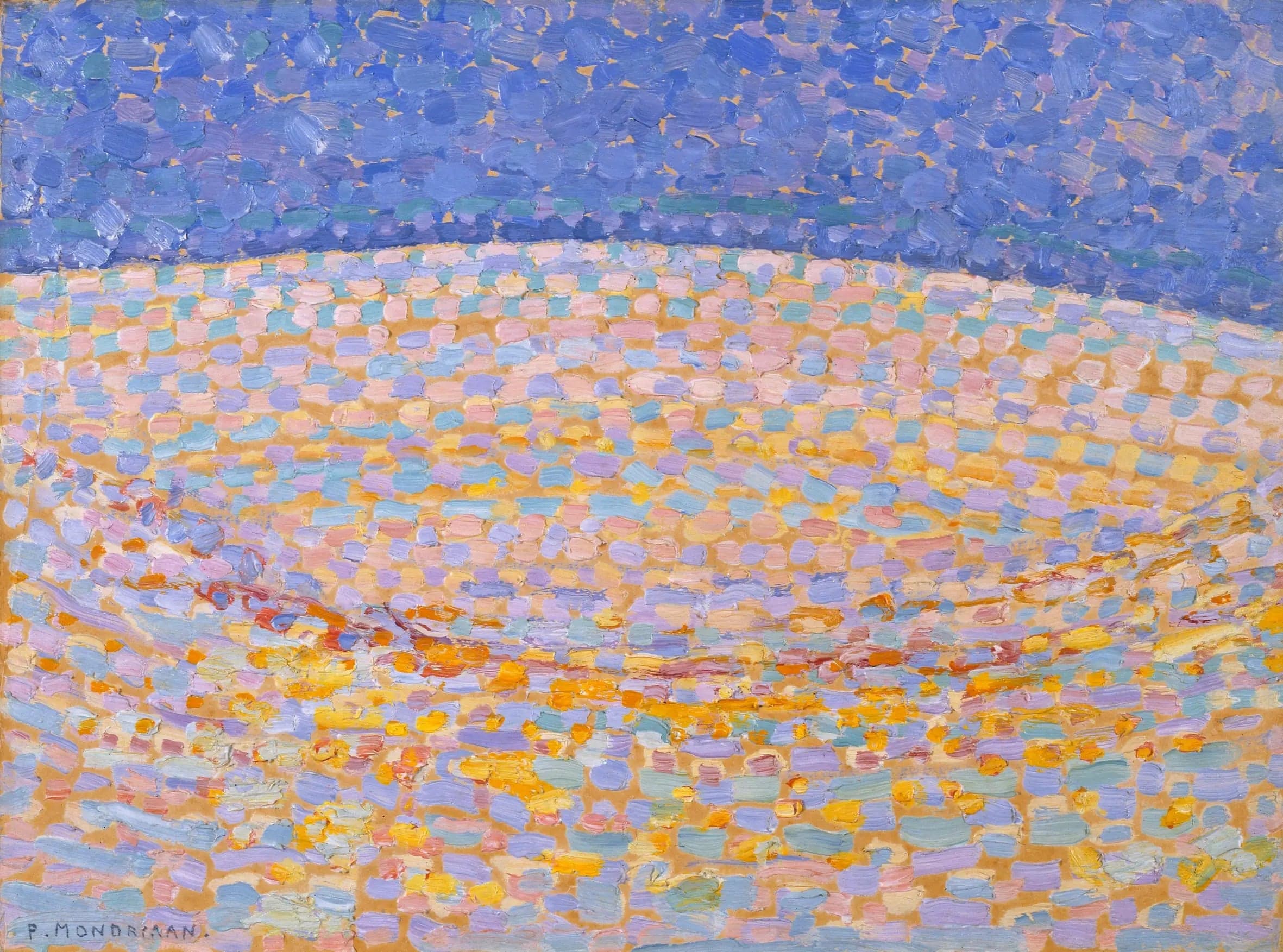
Dune III
- Original dimensions
- 39 x 29.5 cm
- Museum
- Art Museum of The Hague
- Year
- 1909
Scene depicted
The painting "Dune III - Piet Mondrian " showcases a subtle synergy between realism and abstraction. The scene depicts a dune, a symbol of nature in motion, capturing both the serenity and the dynamics of the earth. Each area of color is meticulously arranged to evoke the undulations of the coastal landscape, a wonder that invites meditation.
Historical context
Year: 1909 |BRK| Museum: Art Museum of The Hague |BRK| Dimensions: 39 x 29.5 cm
Place in the artist's career
"Dune III" represents a milestone in the career of Piet Mondrian , illustrating his transition to a more radical abstraction. Anticipating his later works, such as "Composition in Red, Blue, and Yellow," Mondrian establishes here a foundation of interaction between forms and colors, a prerequisite for his later explorations in artistic purity. Compared to "Composition with Blue, Red, and Yellow," this painting reveals an evolution in the use of colors to influence the viewer's emotion.
Anecdote
Piet Mondrian once stated: "Simplicity is the master of complexity" while observing a tranquil dune at sunrise. That morning, the golden light reflected on the grains of sand, inspiring the composition of this pictorial work. Through "Dune III," each brushstroke seems to whisper this truth, paying homage to natural landscapes while leaving a unique imprint on the viewer's soul.