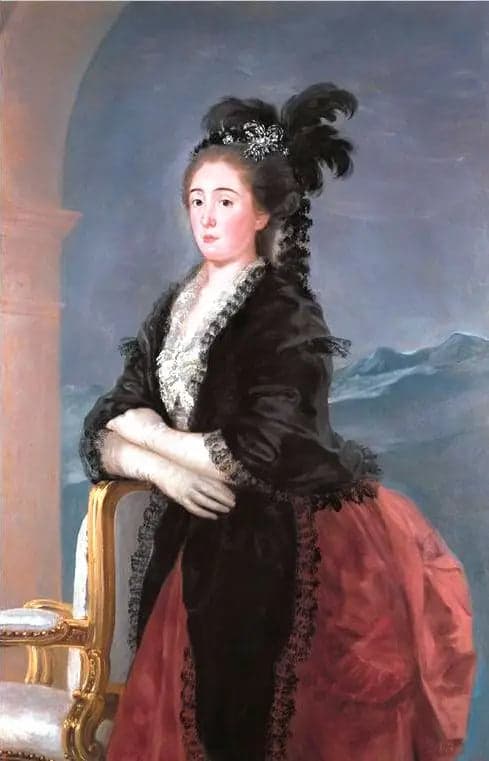
Doña María Teresa de Vallabriga
- Original dimensions
- 97.8 x 151.2 cm
- Museum
- Neue Pinakothek, room 1
- Year
- 1783
Scene depicted
The painting "Doña María Teresa de Vallabriga" depicts with virtuosity the nobility of its model. This sublime portrait, where the young woman is draped in a dress fashionable of the time, evokes the cleanliness of lines and the softness of shades, capturing not only the elegance of clothing but also the soul of an era, where luxury mingled with simplicity.
Historical context
Created in 1783, the painting "Doña María Teresa de Vallabriga" is an emblematic work of the romantic movement that was emerging in Spain during the 18th century. Located in Munich at the famous museum Neue Pinakothek, this canvas is a window into a time when art intertwined with the court and the aristocracy, the artist Goya capturing a moment of elegance and feminine grace in a rich and influential cultural panorama.
Place in the artist's career
This painting represents a milestone in Goya's career, illustrating his skill in blending realism with a romantic sensibility. By positioning it alongside his famous work "La Maja Desnuda" and the masterpiece "The Portrait of the Duchess of Alba," one can perceive his stylistic and emotional evolution, moving from the idealized curve to the power of the natural.
Anecdote
"A moment frozen, a life retraced," Goya might have declared one April morning, inspired by the serenity of Doña María's face in the dreary rays of the sun. This canvas was born from a shared glance in the gardens of the Spanish court, and through it, one feels the passionate affection of the artist for his model, inscribing itself in personal and collective history.