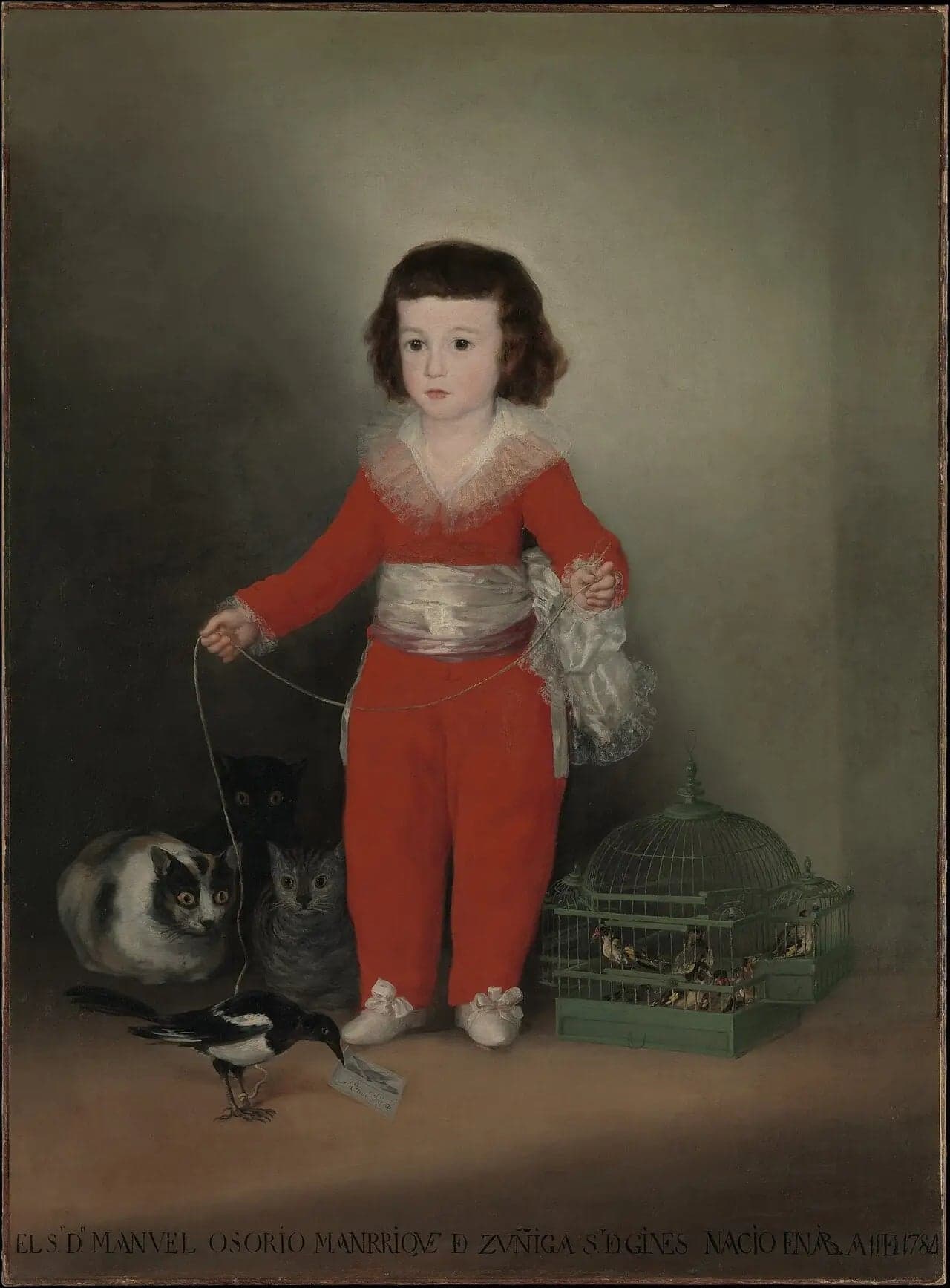
Don Manuel Osorio de Zuniga
- Original dimensions
- 101.6 x 127 cm
- Museum
- Gallery 619, Goya and Eighteenth-Century Italy, Metropolitan Museum of Art
- Year
- 1787
Scene depicted
The painting reveals the young boy surrounded by toys, including a cat. His confident posture, radiant gaze, and the choice of surrounding elements highlight an innocent beauty through the filter of Goya's perception. This pictorial work is a window into childhood, revealing hidden narratives of familial love and wonder beneath the surface.
Historical context
The famous painting by Goya was created at the end of the 18th century in Madrid, a vibrant city that was then the heart of the Spanish court. Emanating from the movement of romanticism , this canvas is the result of a time marked by political and artistic upheavals. The painting "Don Manuel Osorio de Zuniga" remains preserved at the prestigious Metropolitan Museum of Art in New York, where its charm and beauty continue to move visitors from around the world.
Place in the artist's career
Located at the beginning of Goya's career, this canvas constitutes a cornerstone of his artistic expression, combining realism and sensitivity. By holding "La Maja Desnuda" and "The Executions of May 3" in parallel, one observes the evolution of his style, moving from peaceful contemplation to bold social critique.
Anecdote
Goya said: "In every shadow, there is a light waiting to be revealed." This sentiment could summarize the moment he decided to capture the innocence of his young model, Manuel Osorio, on a sunny morning. The setting, filled with light and children's laughter, inspired this magnificent masterpiece , revealing the sweetness of a happy childhood, in contrast to the turmoil of his time.