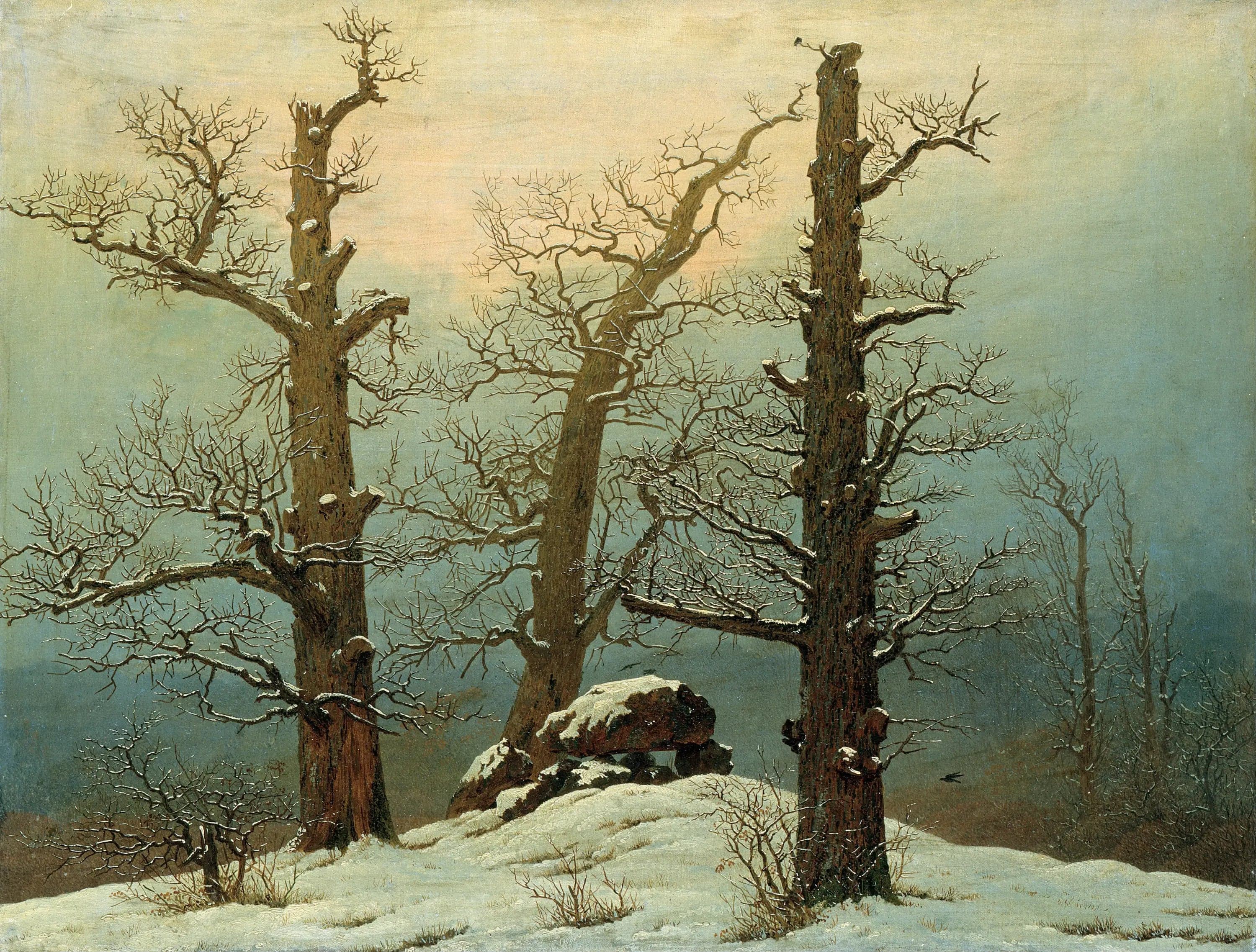
Dolmen Under the Snow
- Original dimensions
- 80 x 61 cm
- Movement
- romanticism
- Museum
- Galerie Neue Meister
- Year
- 1807
Scene depicted
The scene of "Dolmen in the Snow" transports us to a winter landscape where an ancestral dolmen stands, an eternal symbol of human history. The snow, like a gentle blanket, erases the contours and invites reflection. This painting magnifies the contrast between the ephemeral and the eternal, punctuating the silence with a mystical and contemplative atmosphere.
Historical context
Created in 1807, the painting "Dolmen in the Snow" is part of the romantic movement, an artistic current that celebrates emotion and nature. It was in Dresden, a culturally rich German city, that this iconic canvas was born. At that time, Friedrich, inspired by the austere yet majestic landscapes, sought to capture the sublime beauty of nature. This masterpiece , currently housed in the Galerie Neue Meister , is a pictorial work that reveals itself to be both immersive and contemplative.
Place in the artist's career
This canvas represents a key moment in Friedrich's career, affirming his distinctive style and his quest for emotional depth. Alongside it, other major works like " Wanderer above the Sea of Fog " and " The Sea of Ice " illustrate a technical evolution and a unique spiritual quest at the heart of romanticism .
Anecdote
Friedrich is said to have declared: "Nature is not a blank canvas to paint on, but a melody to compose." This canvas was born on a cold winter morning, when the deceptive silence of the snow covered the world. This canvas reflects the encounter of man with the vast and the immutable, awakening in us a feeling of nostalgia and melancholy.
Major exhibitions
Dahl and Friedrich. Romantic Landscapes