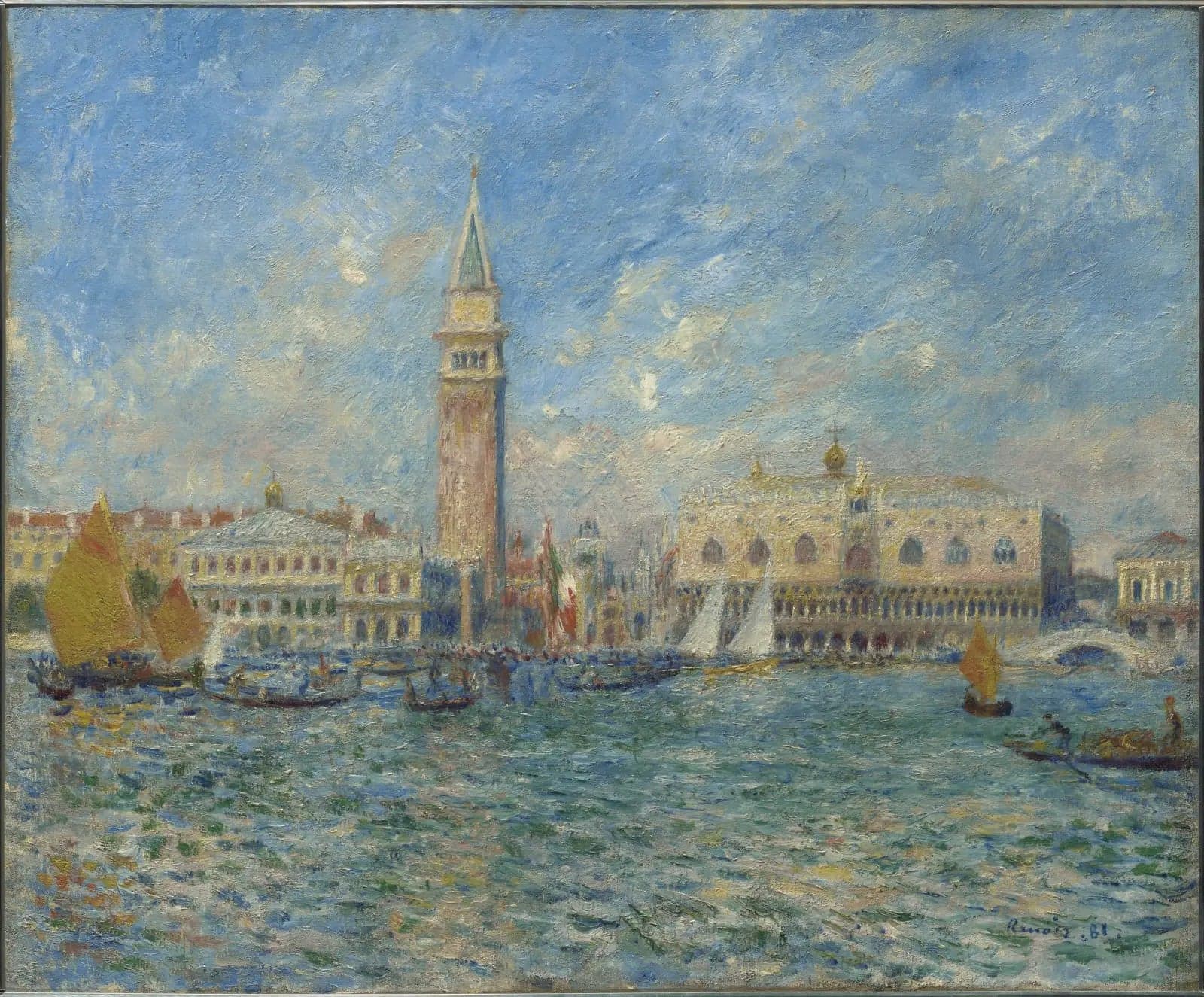
Doge's Palace, Venice - Pierre
- Original dimensions
- 65 x 54.5 cm
- Museum
- Clark Art Institute
- Year
- 1881
Scene depicted
This painting represents the majesty of the Palace of the Doges, an icon of Venetian architecture. The Palace, a symbol of the power and influence of the Republic of Venice, reveals itself under a bright and vibrant sky, creating an atmosphere that is both serene and tinged with nostalgia. Renoir, with his Impressionist approach, reveals the subtleties of this historic building, making this pictorial work a true journey through time.
Historical context
Created in 1881, this painting is located in the heart of splendid Venice, a city that has always inspired artists with its sparkling canals and fascinating architectural heritage. The Impressionist movement, to which this canvas belongs, seeks to capture the nuances of light and the vibrancy of colors. Present at the Clark Art Institute , this work measures 65 x 54.5 cm, perfectly encapsulating the essence of the Serenissima.
Place in the artist's career
This canvas marks an emblematic phase in Renoir's career. At this time, he explores the interplay of light and color while consolidating his Impressionist style. Meanwhile, his works such as “Luncheon of the Boating Party” and “Dance in the City” testify to his artistic evolution, oscillating between everyday life and the serenity of naturalistic landscapes.
Anecdote
“Light is my greatest ally,” Renoir said, referring to the inspiration that led him to create this masterpiece . Imagine a spring morning in Venice, where the sun's rays dance on the walls of the Palace of the Doges, and a light scent of wildflowers floats in the air. It is in this atmosphere that Renoir captured the fleeting beauty of the scene, thus nourishing the deep emotion of the painting .