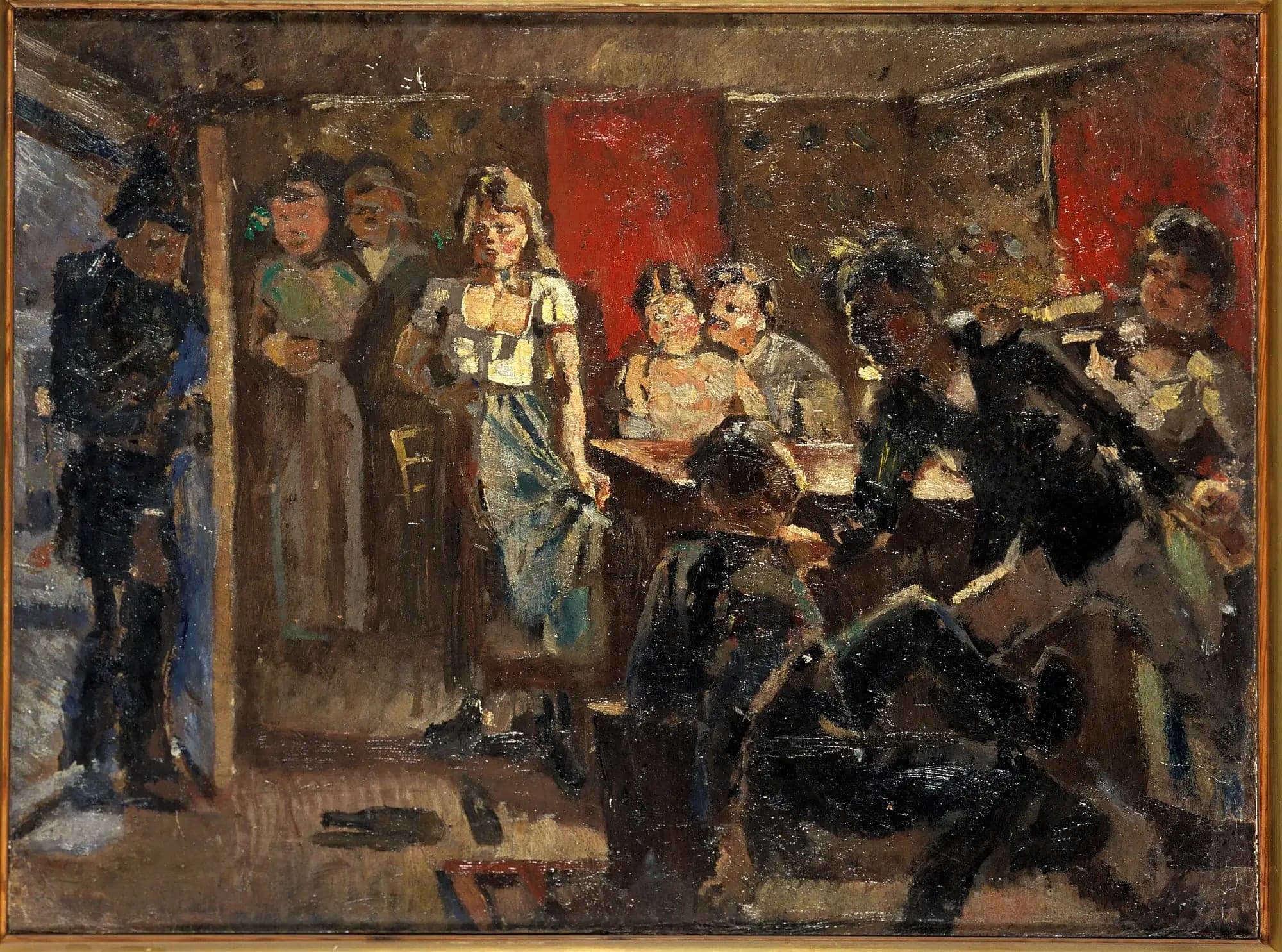
Dive at Vaterland
- Original dimensions
- 63.5 x 47 cm
- Museum
- Munch Museum
- Year
- 1882
Scene depicted
In this painting , Munch takes us to the water's edge, where the horizon is illuminated by a delicate palette. An elegant diver, enveloped by the play of waves, embodies a quest for escape and freedom. The fluid lines and stylized forms evoke a world in harmony, while revealing an underlying fragility, blending dream and reality.
Historical context
Created in Oslo, Norway, in 1882, the painting titled Diving at Vaterland is part of the Symbolist movement, emerging from a context rich in emotions and artistic tensions. This work, currently housed in the Munch Museum, resonates with the innovative spirit of its time, imbued with reflections on the human condition and nature.
Place in the artist's career
Diving at Vaterland marks a crucial milestone in the career of Edvard Munch , reflecting his artistic evolution. At this time, the artist explores his visual language, contrasting with earlier works like The Scream and Madonna , where raw emotion was more palpable. Here, he reaches an intermediate stage, where the tone becomes softer, revealing a growing emotional maturity.
Anecdote
Edvard Munch , in a letter to a friend, once wrote: "Art is a cry of the soul, a call that transcends words." The moment of inspiration for Diving at Vaterland was a spring morning, where he wandered along the shores of the fjord, lost in thought, capturing the ephemeral beauty of the moment. This melancholic scene is now immortalized in his painting .