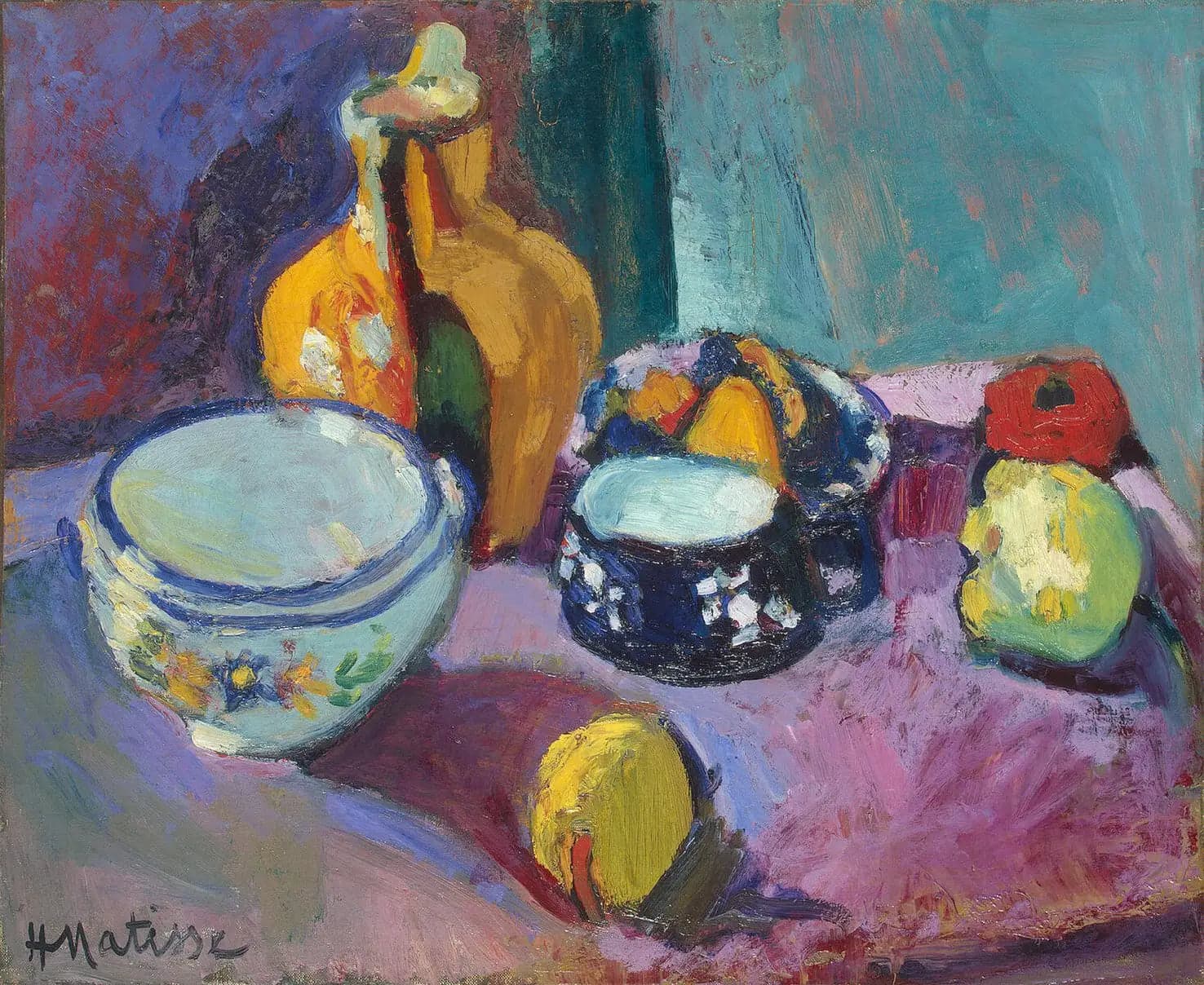
Dishes and Fruits
- Original dimensions
- 61.5 x 51 cm
- Museum
- Hermitage Museum
- Year
- 1901
Scene depicted
In Plates and Fruits , Matisse captures the essence of a sensory daily life. Skillfully arranged on a table, the opulent fruits and delicate plates seem to dance under the light. Each color is filled with life and evokes a tactile presence. This canvas does not merely represent a meal; it tells a feast of the senses, an invitation to immerse oneself in a moment of conviviality illuminated by Fauvism .
Historical context
Created in 1901, within the fertile framework of Fauvism , the painting Plates and Fruits comes to life on the canvas as Matisse explores the chromatic and expressive possibilities of art. Located in France, this painting is an integral part of a time when color and emotion took precedence over realistic rendering. Currently exhibited at the Hermitage Museum , this painting with precise dimensions of 61.5 x 51 cm testifies to the artistic boldness of its time.
Place in the artist's career
As one of the paintings marking the beginning of his career, Plates and Fruits announces the bold style that will make Matisse famous. In parallel with The Dance (1910) and Monet's Water Lilies , one perceives the maturation of his pictorial language: the liberation of forms and colors paves the way for an evolution towards emotional purity.
Anecdote
"Color is a force. It has the power to change the vision of the world." Inspired by the brightness of a spring morning, Matisse painted these fruits and plates in a vibrant burst of creativity. This fleeting moment is the origin of his masterpiece , where each shape evokes the sweetness of a day that begins.