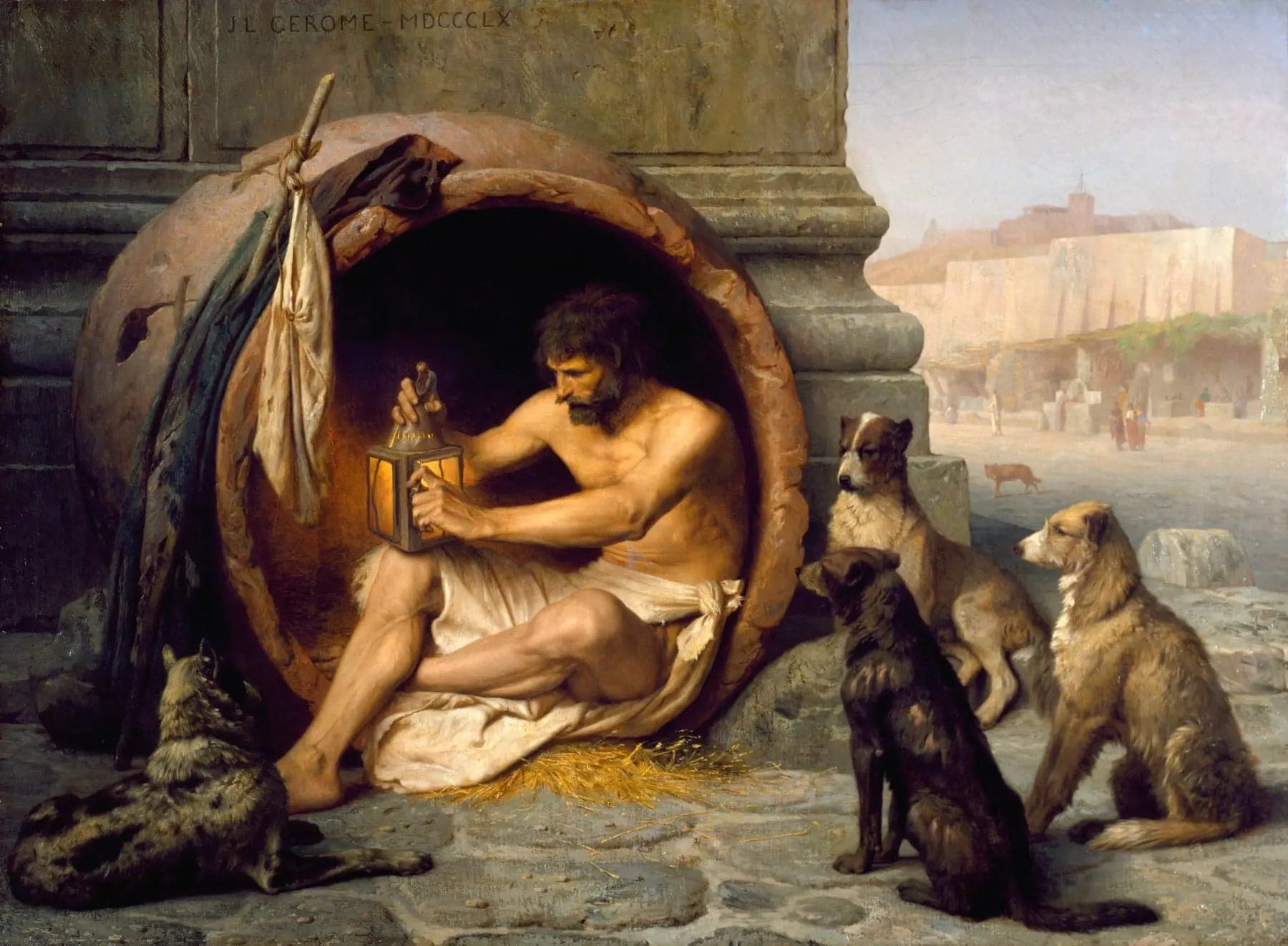
Diogenes - Jean
- Original dimensions
- 101 x 74.5 cm
- Movement
- academicism
- Museum
- Walters Art Museum
- Year
- 1860
Scene depicted
In this painting , Diogenes of Sinope is strikingly portrayed, with his lantern, a symbol of the quest for truth, and his provocative attitude. This pictorial work traces the very essence of philosophical cynicism in the face of society. The artist, with impeccable mastery, immortalizes this moment of defiance, making this masterpiece a timeless reflection on the human condition.
Historical context
Created in 1860 in Paris, this painting is emblematic of the academic movement, reflecting a time when art exalted technical perfection and classical beauty. This canvas , now housed in the Walters Art Museum in Baltimore, evokes a pivotal moment in the history of art, between tradition and modernity. With generous dimensions of 101 x 74.5 cm, it captures attention and invites deep contemplation.
Place in the artist's career
"Diogenes" marks a turning point in Gérôme's career. At this time, he oscillates between a rigorous representation of historical scenes, as in his famous painting "The Gladiators," and a more poetic approach, as in "The Dance of the Oriental Dancer." This painting represents a period of maturity where the artist begins to refine his style, exploring bolder and more provocative subjects.
Anecdote
Jean-Léon Gérôme once stated: "Painting is the mirror of our soul." This quote resonates vibrantly in his masterpiece "Diogenes," inspired by the legend of the Greek philosopher who sought the truth in broad daylight. Imagine Gérôme, on a sunny morning, wandering the streets of Paris, drawing inspiration from scenes of daily life: a glance, a silhouette, that would become eternal through his canvas .