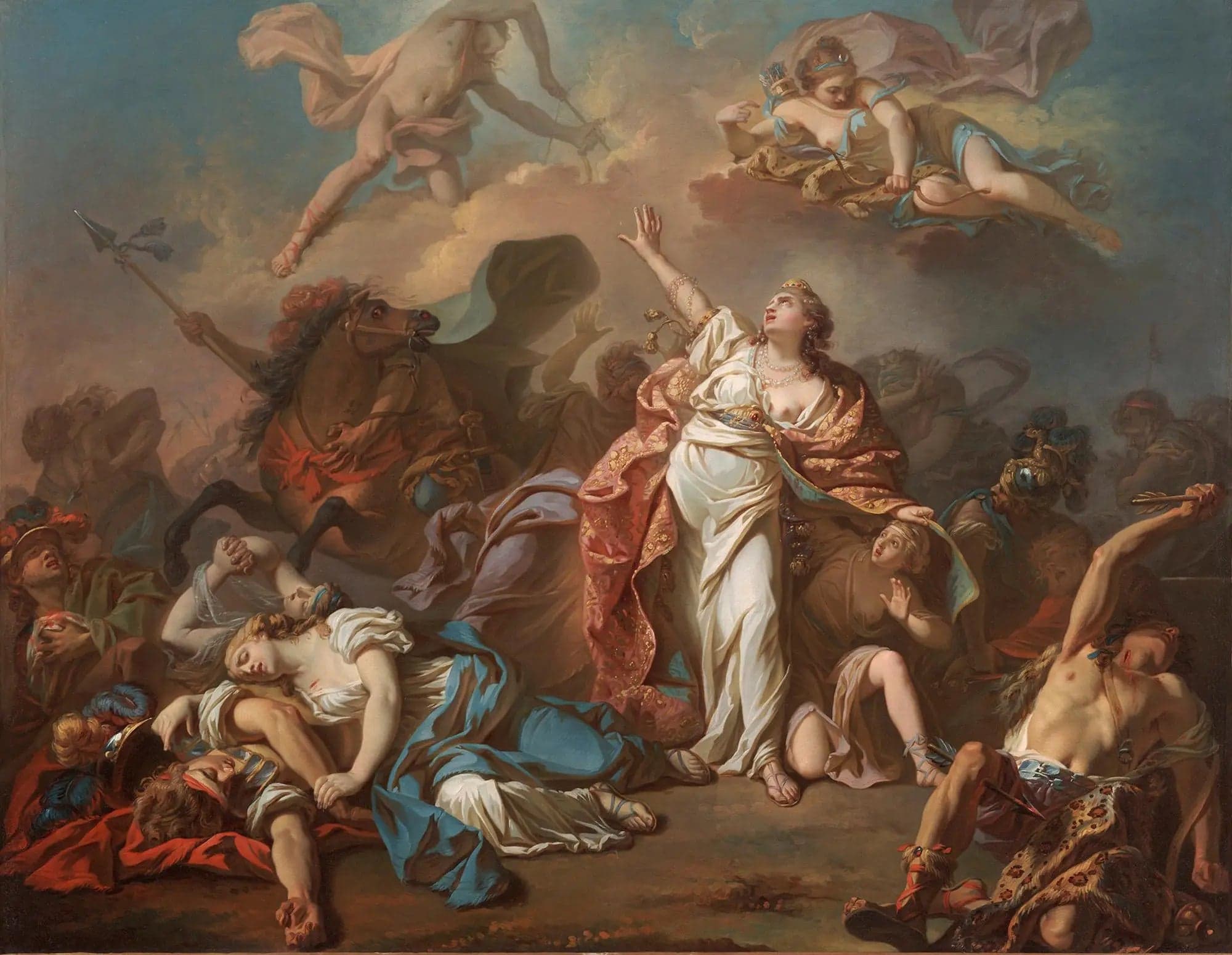
Diana and Apollo piercing the children of Niobe with their arrows - Jacques
- Original dimensions
- 153.67 x 120.65 cm
- Movement
- neoclassicism
- Museum
- Dallas Museum of Art
- Year
- 1772
Scene depicted
This canvas , fascinating for its dramatic intensity, illustrates the myth of Niobe, queen of Thebes, who boasts of being more fertile than Leto, mother of the deities Apollo and Diana. In response to her arrogance, the latter, accompanied by his sister, inflicts inhumane punishment, piercing Niobe's offspring with their arrows. The painting evokes pain and despair, conveying to the viewer the horror and majesty of tragedy.
Historical context
Created in 1772, this painting embodies the roots of the city of Paris, at the heart of the neoclassical movement. At a time when Europe is brimming with artistic and political aspirations, the canvas by Jacques-Louis David stands as a beacon of emotion and virtuosity. Today, this remarkable work is carefully preserved at the Dallas Museum of Art , with dimensions of this masterpiece, 153.67 x 120.65 cm, attesting to its striking presence.
Place in the artist's career
Situated in the maturity of his career, Diana and Apollo Piercing Niobe's Children with Their Arrows embodies the pinnacle of David's style. Compared to his other masterpieces such as " The Oath of the Horatii " and " The Death of Socrates ", this painting marks a technical turning point where emotion goes hand in hand with striking realism.
Anecdote
“Art must be an echo of human passions,” he often said. Imagine him, one spring morning, contemplating the play of shadows and light in a quiet alley. It is there, amidst the tranquility, that the inspiration to create Diana and Apollo Piercing Niobe's Children with Their Arrows took shape, a poignant fusion of maternal love and divine vengeance.