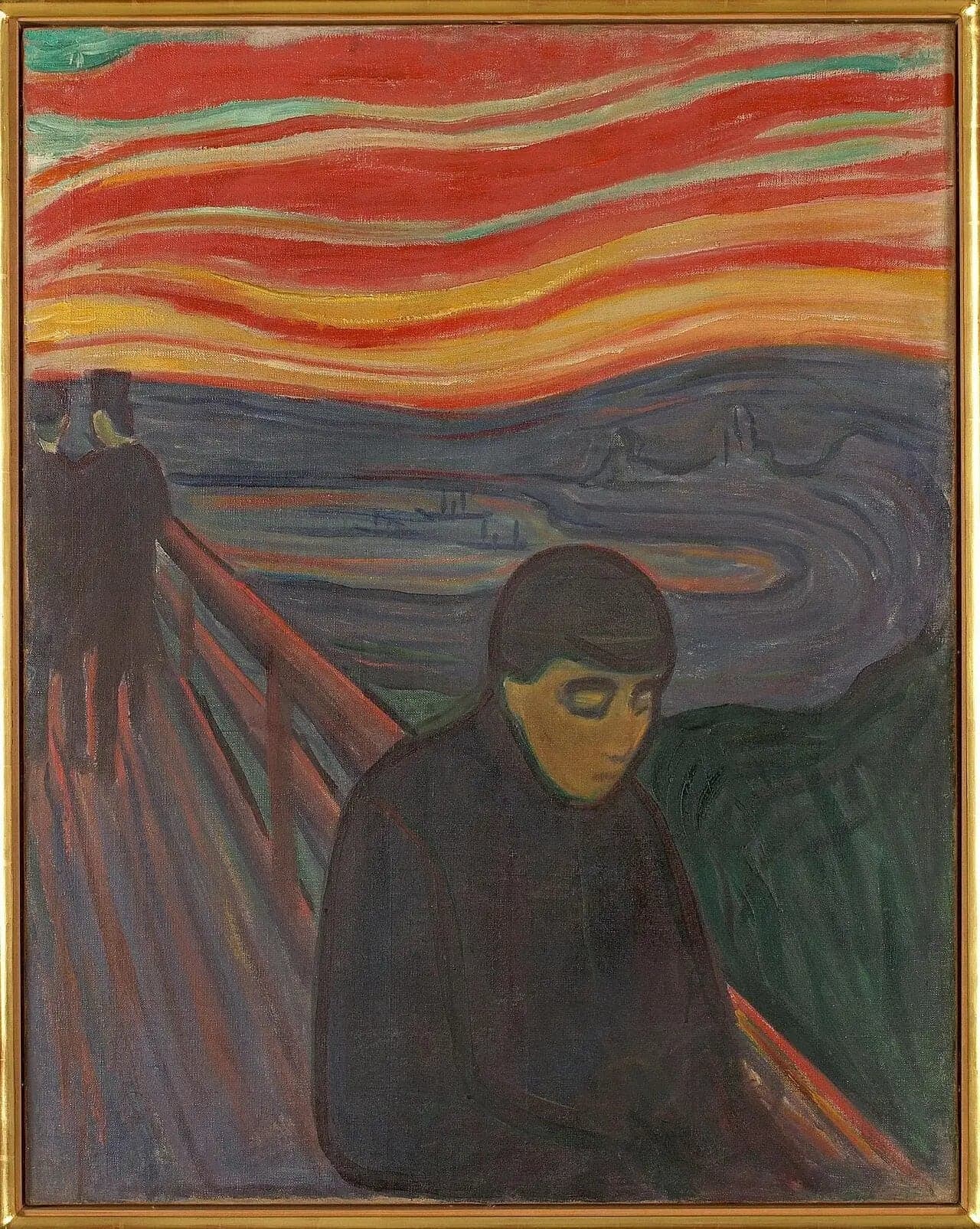
Despair
- Original dimensions
- 67 x 92 cm
- Movement
- expressionism
- Museum
- Thiel Gallery
- Year
- 1892
Scene depicted
The painting “Despair” transports us to a scene filled with tumultuous emotions. It depicts an individual in the grip of deep anguish, set against a tormented landscape. The contrast between the individual and the environment expresses the duality between the beauty of nature and existential suffering. The tumultuous waves symbolize the inner storm, making palpable the struggle between shadow and light in the human soul.
Historical context
Created in 1892, in Oslo, this canvas is emblematic of the expressionist movement, which disrupts the classical perception of painting. At that time, Europe was undergoing periods of intense social and emotional changes. Currently housed at the Thiel Gallery, this painting vibrant with pain and introspection measures 67 x 92 cm, a size that allows each viewer to immerse themselves in the tumult of the human soul.
Place in the artist's career
Despair marks not only a turning point in Munch's evolution, but it also resonates with “The Scream” and “The Madonna,” revealing the progression of his intense expressionism . These paintings reflect the artist's desperate quest to capture his tumultuous and suffering inner world, placing this canvas in an emotional pantheon of his artistic corpus.
Anecdote
Edvard Munch once shared: “It is in the silence of the night that I felt the cry of the soul.” Inspired by an evening when he walked along the shores of a Norwegian fjord, a melody laden with melancholy led him to capture the very essence of human suffering, which is purged in his painting Despair .