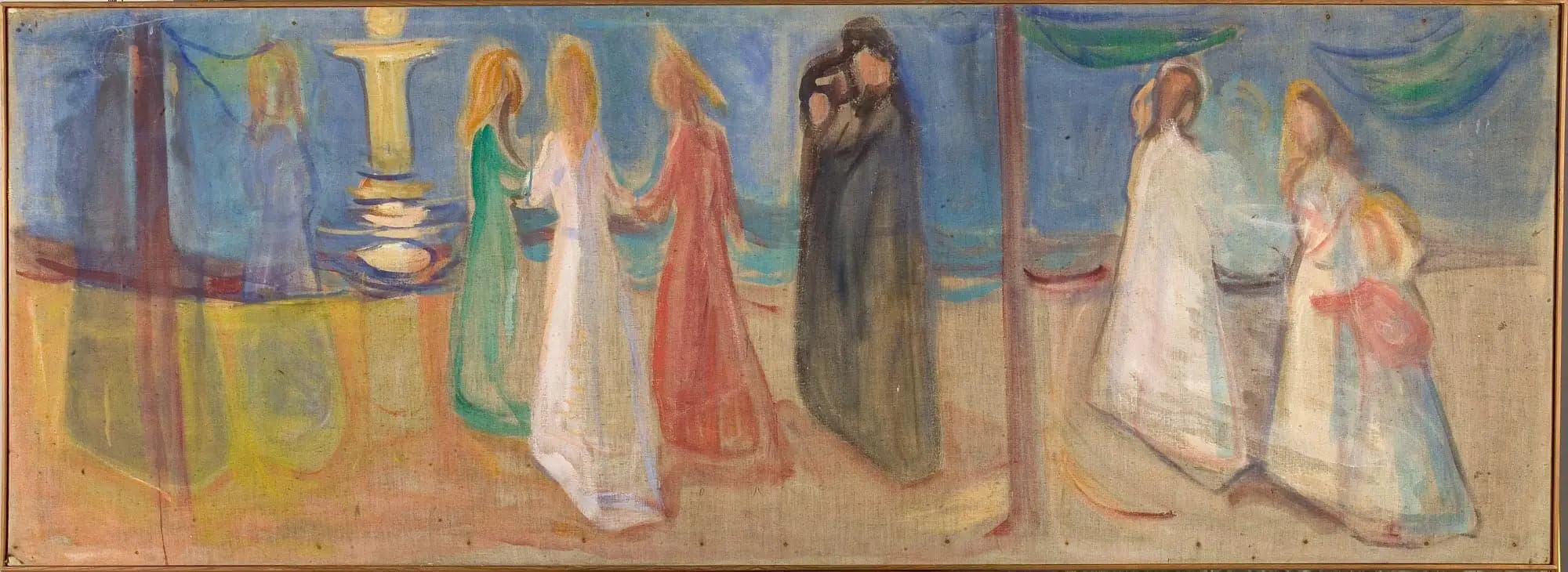
Desire
- Original dimensions
- 249.5 x 90 cm
- Museum
- Munch Museum
- Year
- 1906
Scene depicted
In "Desire," Edvard Munch captures a moment of emotional tension between the protagonists. The composition illustrates a silent dialogue, imbued with passion, where desire and melancholy intertwine. This work, both intimate and universal, explores the shadows and lights of human relationships, revealing buried narratives that still resonate today.
Historical context
Created in 1906, in the heart of Oslo, this canvas illustrates the power of symbolism , a revolutionary artistic movement at the turn of the 20th century. As Europe vibrates to the tempo of modern changes, the painting "Desire" emerges as a poignant echo of the inner quest. Currently exhibited at the Munch Museum, this pictorial work invites us to dive into the intimacy of human emotions through dimensions that make it both imposing and captivating.
Place in the artist's career
The canvas "Desire" is situated in a pivotal period of Munch's career, where his style and artistic vision take flight. Alongside "The Scream" and "The Madonna," this painting synthesizes his exploration of human emotions, marking a turning point in his aesthetic and psychological approach.
Anecdote
“Art must be an expression of life, a resonance of deep emotions,” said Munch. Imagine him, as one spring morning, he strolls along the docks of Oslo, absorbed by the whispers of the water and the scents of urban life. This scene, rich in sensations, undoubtedly nourished the inspiration behind his masterpiece that we admire today.