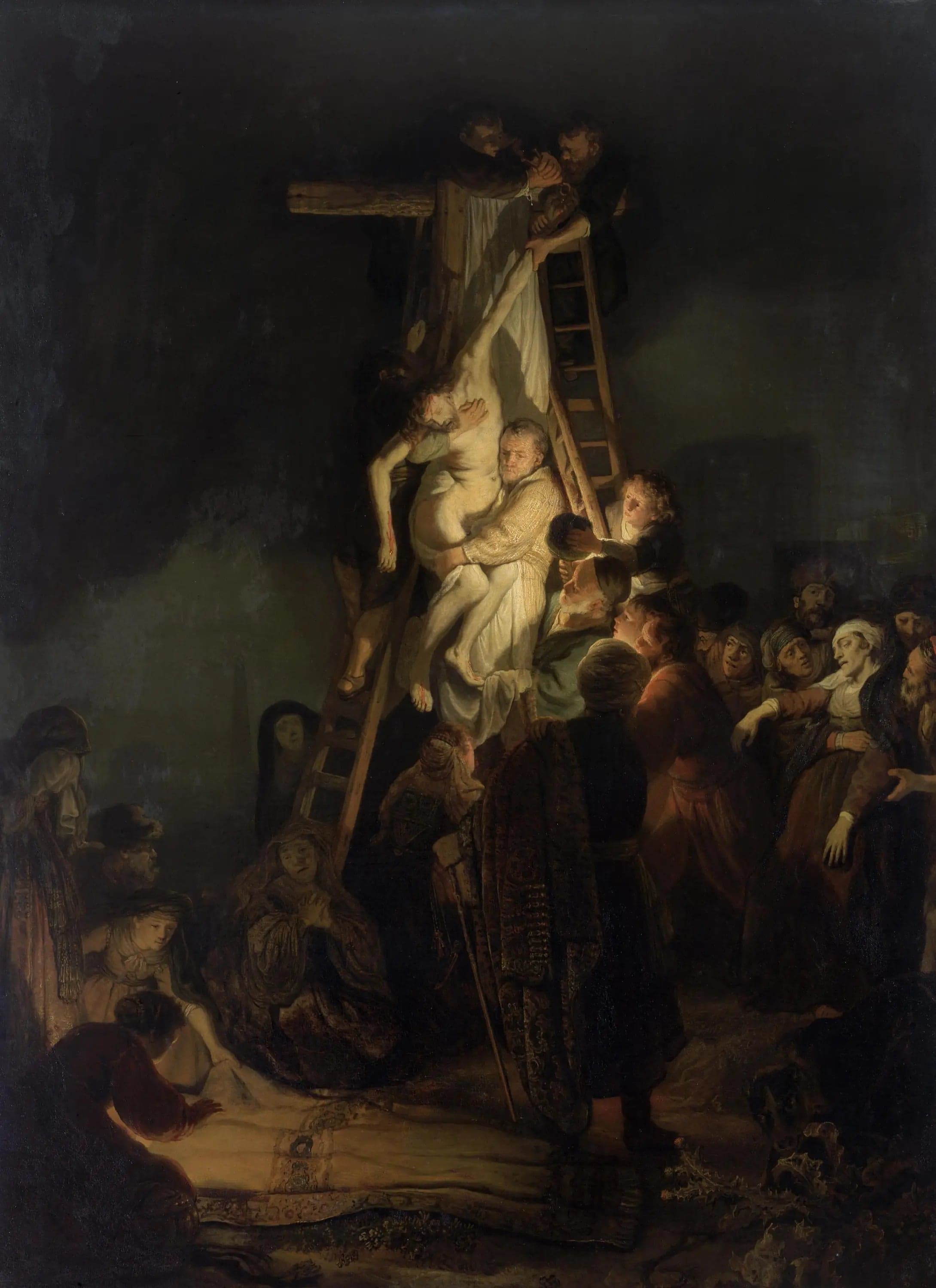
Descent from the Cross
- Original dimensions
- 110.9 x 142 cm
- Movement
- Dutch Golden Age of painting
- Museum
- National Gallery of Art
- Year
- 1650
Scene depicted
“Descent from the Cross” illustrates the poignant moment when the body of Christ is gently laid in the arms of his loved ones. The figures, with their expressive richness, carry the sadness of a loss, blending the sacred and the human. The light plays with the shadows, creating an atmosphere that is both solemn and vibrant, revealing the conflicts of the soul in the face of suffering.
Historical context
The year 1650 stands out for its unparalleled artistic effervescence in Amsterdam, then a true cradle of the Dutch Golden Age of painting. It is here that Rembrandt , the undisputed master, signed his famous painting "Descent from the Cross," a canvas of fascinating emotional depth. Now displayed at the National Gallery of Art , this work testifies to a time rich in pictorial discoveries and stylistic innovations.
Place in the artist's career
This painting is situated at a crucial turning point in Rembrandt 's career, where his quest for stylistic perfection reaches a peak. Alongside it, two other notable pieces like "The Night Watch" and "Girl with a Pearl Earring" show his evolution, both in the treatment of light and in the emotions represented. “Descent from the Cross” reflects an unprecedented artistic maturity.
Anecdote
“Light is the language of the heart” could have said Rembrandt , captivated by a mystical inspiration. Imagine him, isolated in his studio, caressed by the morning light, sketching the outlines of a composition that captured the pain and sublimity of the scene. This fleeting moment became the soul of this painting , and the memory of a Parisian spring mingles with the tears of the apostles.