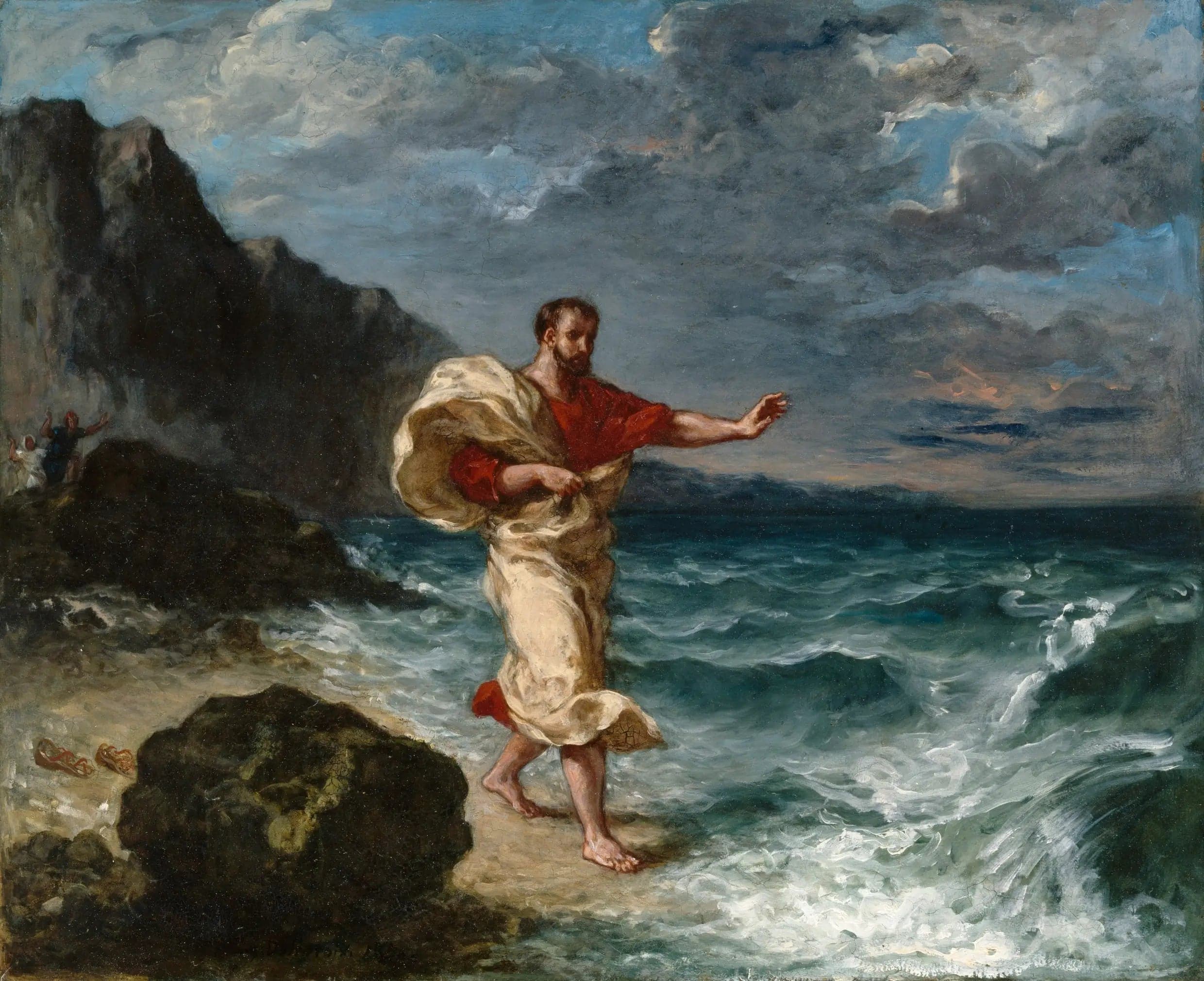
Demosthenes by the Sea
- Original dimensions
- 60 x 49 cm
- Museum
- National Gallery of Ireland
- Year
- 1859
Scene depicted
This canvas, frozen in time, represents the great orator Demosthenes, contemplating the horizon by the sea. The tension between the orator's passion and the power of the surrounding nature testifies to the human struggle against the elements. Delacroix, through his play of light and color, immerses us in the heart of an intense moment of reflection, where the roaring sea seems to reflect Demosthenes' inner turmoil.
Historical context
The painting "Demosthenes by the Sea" finds its roots in 19th century Paris, as the artist Eugène Delacroix gazes upon the tumultuous beauty of the sea. A manifestation of emerging romanticism, this canvas is emblematic of a time when emotion and nature intertwine poignantly. This masterpiece, currently housed in the National Gallery of Ireland , embodies the boldness of a movement that advocates for personal expression and the exaltation of sensations.
Place in the artist's career
"Demosthenes by the Sea" is part of a pivotal period in Delacroix's career, where he manages to synthesize romantic emotion with great technical mastery. This painting, alongside " Liberty Leading the People " and " The Death of Sardanapalus ", illustrates the stylistic evolution and iconographic intensity that will mark his work, testifying to an artist at the height of his art.
Anecdote
"It is in the crash of the waves that I found the soul of my canvas," would have declared Eugène Delacroix one day, recalling his inspiration for this masterpiece . One spring morning, facing the immensity of the sea, he realized that the true essence of life lies in movement and passion, elements that vibrate intensely in this painting .