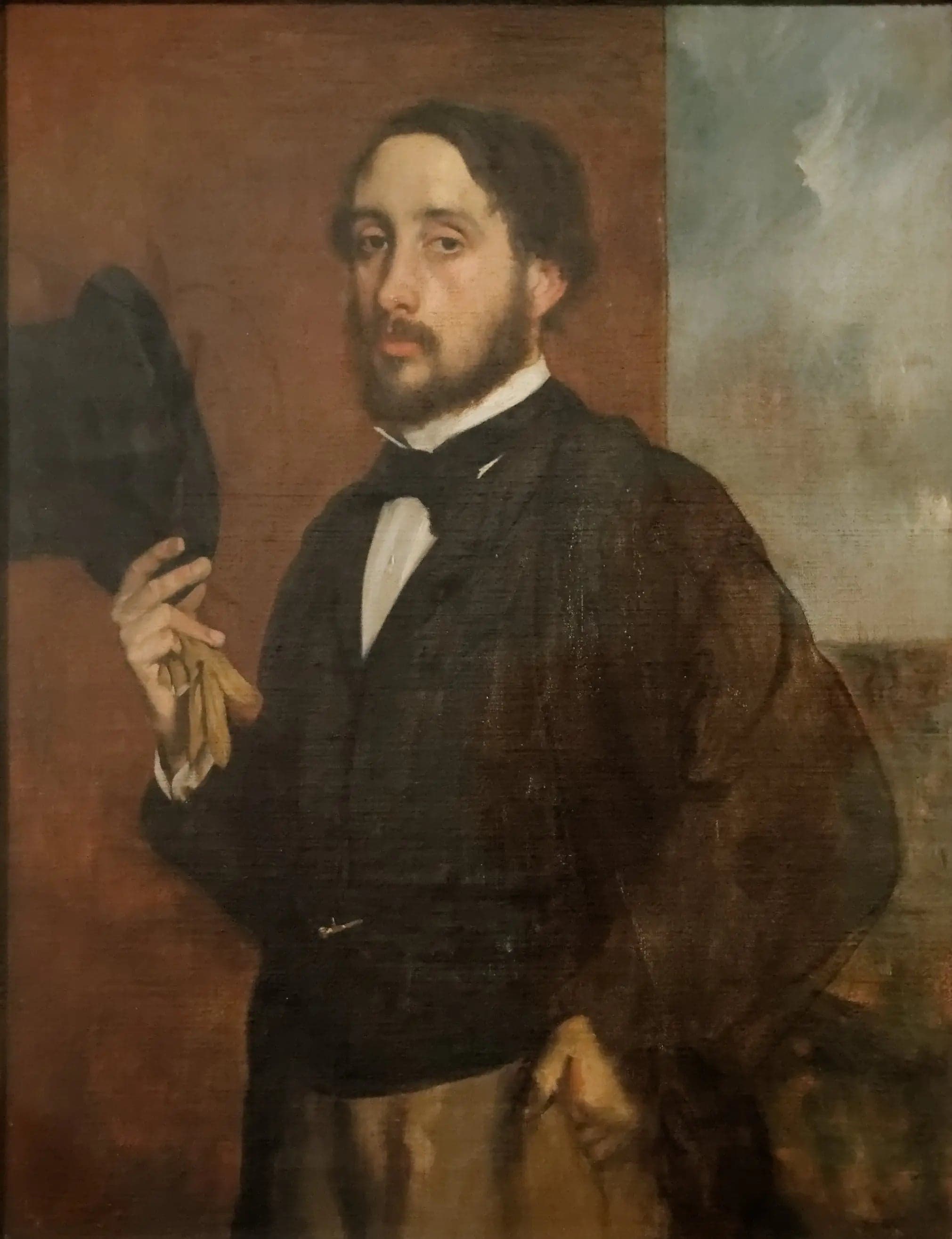
Degas Greeting
- Original dimensions
- 69 x 92 cm
- Museum
- Calouste-Gulbenkian Museum
- Year
- 1863
Scene depicted
The painting "Degas saluant" depicts a vibrant scene of human interaction, capturing the graceful elegance of a character majestically greeting. This movement, enhanced by the skillfully crafted composition, evokes an enchanting atmosphere where the viewer's gaze is lost both in the dynamics of the canvas and in the intimacy of a shared moment.
Historical context
Created in 1863 in Paris, the painting "Degas saluant" is part of the Impressionist movement, a revolutionary artistic current of its time. This iconic painting reveals both the essence of Parisian life and the fragility of the moments captured by the artist. Currently, this canvas is displayed at the Calouste-Gulbenkian Museum , where it continues to amaze visitors with its emotional depth and decorum.
Place in the artist's career
This painting stands as one of the major milestones in the artistic evolution of Edgar Degas . Although he started with an academic approach, works such as "The Dance Class" and "The Dancers" illustrate his transition to a bolder and more personal expression. With "Degas saluant," the artist achieves a stylistic mastery that elevates him to the ranks of the great masters of art.
Anecdote
Edgar Degas once expressed: "Beauty is in the moment, you must know how to catch it." Imagine him, strolling through the streets of Paris, on a sunny morning, when an ordinary gesture – a greeting exchanged – inspired him to create this masterpiece . Each brushstroke in "Degas saluant" imbues this fleeting moment with a vibrant warmth, testifying to the artist's unique talent.