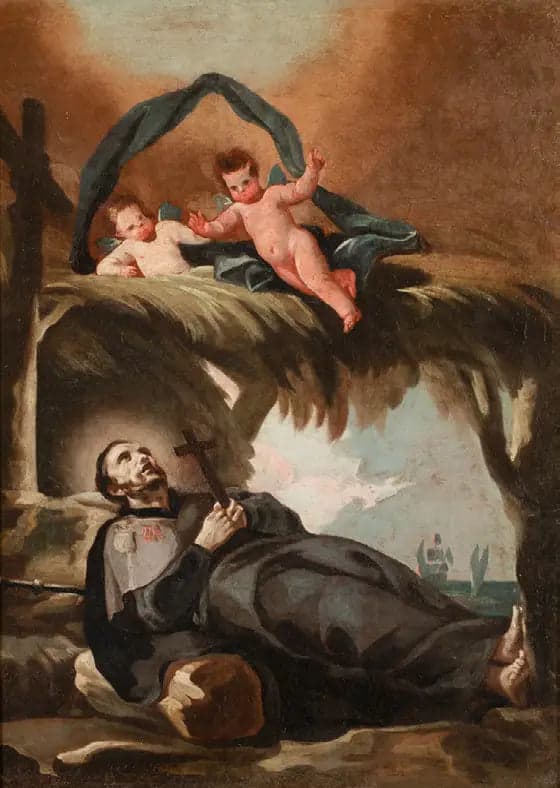
Death of Saint Francis Xavier
- Original dimensions
- 42 x 56 cm
- Museum
- Museum of Zaragoza
- Year
- 1771
Scene depicted
In the painting “Death of Saint Francis Xavier,” Goya depicts the transcendental moment when the saint, after a life dedicated to missions, finds himself in a state of ultimate peace. The dramatic composition, with figures gathered around his lifeless body, reveals the depth of humanity in the face of sacrifice. This canvas embodies not only the end of a life but also hope and redemption, as the saint, enveloped in a soothing light, seems to transcend the mortal world.
Historical context
Created in 1771 in the vibrant city of Zaragoza, this painting is part of the artistic movement of neoclassicism, presenting an emotional scene that engages and reveals the cultural heritage of Spain. It is here that Goya, in a creative frenzy, brings to life a canvas that expresses not only his personal vision but also the spirituality of an era influenced by tales of life and death. The canvas is currently housed in the Museum of Zaragoza, where it continues to captivate visitors with its grandeur.
Place in the artist's career
Through the canvas “Death of Saint Francis Xavier,” Goya asserts himself as a master of drama and emotions. This masterpiece is part of a period where his style evolves, after having created notable works like “The Way of Light” and “The Disasters of War.” These different pieces showcase the evolution of his artistic vocabulary and his commitment to addressing profound human themes.
Anecdote
“I wanted to capture the moment when divine light touches the soul of those who depart.” In a small studio, on a sunny morning, Goya may have been inspired by the song of birds and the sweet scent of flowers, recalling stories of devotion and sacrifice. This ephemeral moment infused this pictorial work with a palpable intensity of emotion.