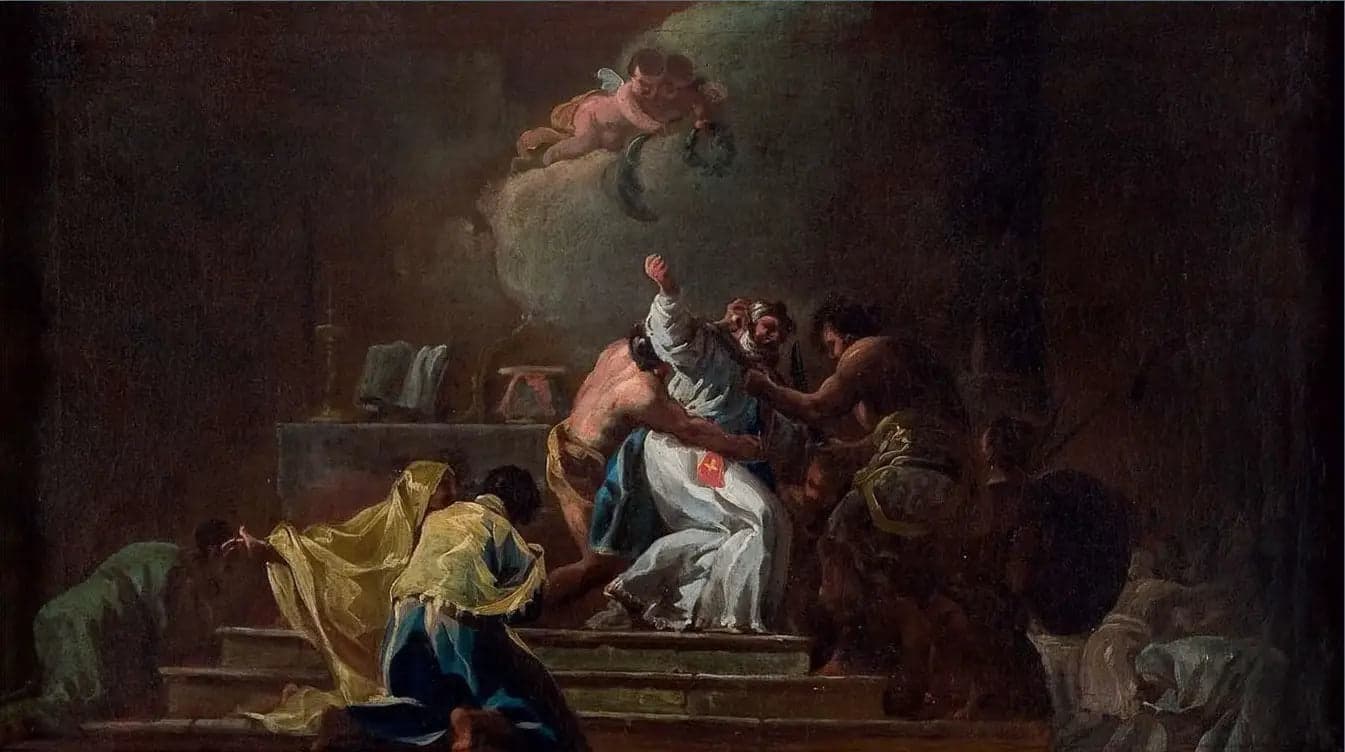
Death of Saint Albert of Jerusalem
- Original dimensions
- 60 x 35 cm
- Museum
- Not specified
- Year
- 1772
Scene depicted
The canvas depicts a tragic moment, that of a saint's death. Goya captures the emotional tension of a scene where expressions of pain and fervor contrast with an almost transcendent light, revealing both human despair and spiritual hope. Each character, each shadow seems alive, resonating with a timeless story and palpable religious fervor.
Historical context
Created in 1772, this painting reflects a pivotal time in Spain, at the crossroads between late baroque and the beginning of neoclassicism. Francisco de Goya , in a creative frenzy far from his future fame, managed to capture the spirit of his time through this poignant canvas . Although the museum where it is currently located is not specified, its dimensions, 60 x 35 cm, make it a centerpiece in any space that hosts it.
Place in the artist's career
This canvas represents a milestone in Goya's career, marking his evolution towards darker and more introspective works. Compared to works such as “The Third of May 1808” and “The Majas on the Balcony,” the technical and emotional progression of the artist is evident, revealing a growing mastery of contrasts and emotional depths.
Anecdote
“Light has always spoken to me,” Goya is said to have remarked, recalling the morning of inspiration during which the composition of this masterpiece took shape. This phrase resonates powerfully with the evocative strength of the painting , an invitation to perceive the light that cuts through the dramatic scene of the death of Albert of Jerusalem.