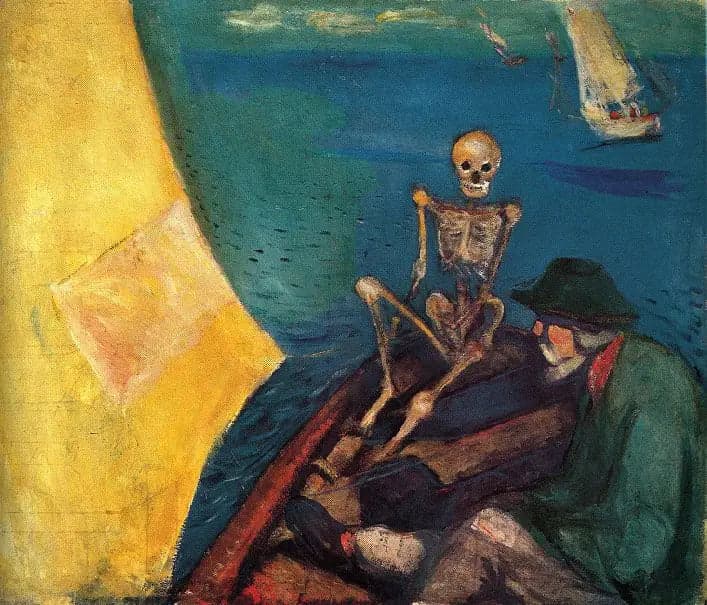
Death at the Helm
- Original dimensions
- 120.5 x 100.5 cm
- Museum
- Munch Museum
- Year
- 1893
Scene depicted
The composition of this canvas reveals a poignant scene where a dead person is brought by the boat of death. Edvard Munch , through the expressive intensity of his technique, depicts the tragic confrontation between life and death, while evoking a deep sense of melancholy. The human figures present a poignant vulnerability, enhancing the emotional impact of the work.
Historical context
Created in 1893 in the vibrant city of Oslo, this painting emanates from the expressionist movement, a current that seeks to translate human emotions through bold forms and colors. The Death at the Helm is today exhibited at the Munch Museum, a place dedicated to preserving the artistic legacy of Edvard Munch , reflecting his troubled era.
Place in the artist's career
“The Death at the Helm” marks a turning point in the career of Edvard Munch , signaling the transition to darker and more introspective themes. Alongside The Starry Night and The Scream , this painting showcases his exceptional technical evolution and intense exploration of feelings, establishing Munch as one of the pillars of expressionism .
Anecdote
“Nightmares have always been my friends,” Munch is said to have remarked during a conversation with a friend. This quote resonates strongly when thinking of the canvas “The Death at the Helm,” perhaps inspired by a night of anguish or a hazy vision of a gray morning. The painting thus captures the intensity of these emotions, making the work deeply personal.