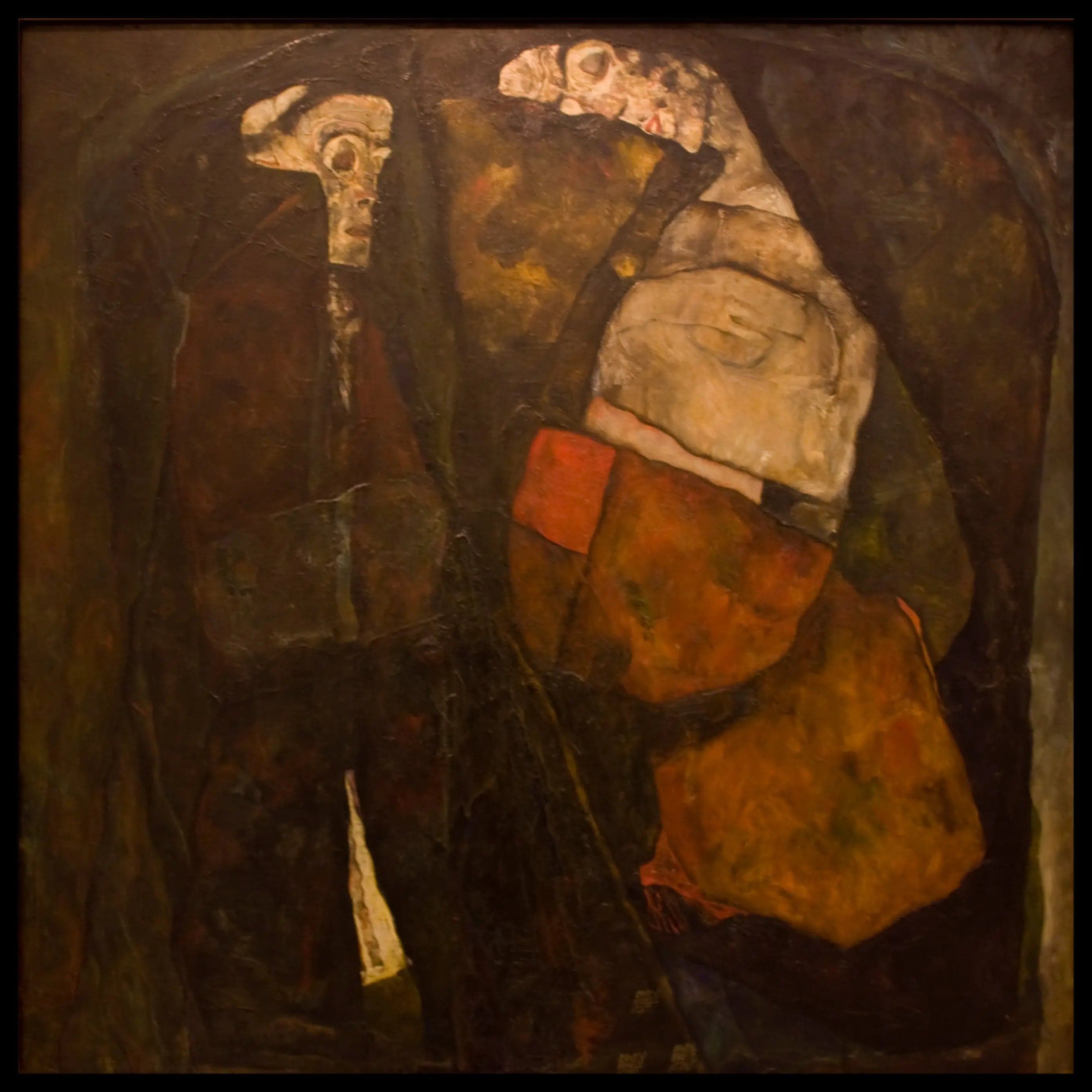
Death and Young Girl
- Original dimensions
- 100 x 100 cm
- Museum
- Veletržní palác
- Year
- 1911
Scene depicted
In this painting, a young girl faces death, embodied by an emaciated corporeal figure. The contrast between the vitality of youth and the inexorability of death creates a palpable tension, a questioning of existence. Every element of the composition contributes to this psychological exploration, where the young girl's face conveys a disturbing melancholy.
Historical context
Created in 1911, during a tumultuous time in art in Vienna, this painting embodies the rebellion and passion that reigned at the height of the expressionist movement. This painting, currently housed at the Veletržní palác , reflects a rich cultural zeitgeist, marking a turning point in the history of modern art.
Place in the artist's career
This painting , the cradle of his artistic evolution, is situated at a pivotal moment in Schiele's career. It follows other paintings , such as “Self-Portrait with a Red Arm” and “Death and the Young Girl” which established his bold style, while paving the way for his unique and expressive approach that continues to inspire contemporary artists.
Anecdote
“Art must reveal what is hidden, it must provoke a deep emotion.” These words of Egon Schiele resonate in every brushstroke of this masterpiece . Inspired by a daily encounter in the streets of Vienna, where the fragile balance between life and death captivated him, his artistic vision brings the canvas to life through a raw sensitivity.