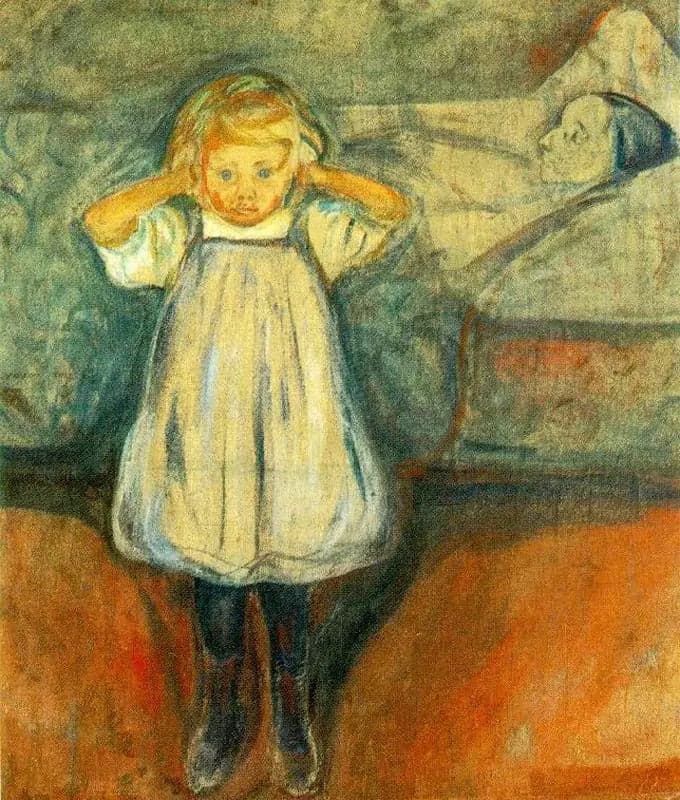
Death and the Child
- Original dimensions
- 90 x 100 cm
- Movement
- expressionism
- Museum
- Kunsthalle Bremen
- Year
- 1899
Scene depicted
This canvas depicts the tragic and tender interaction between a child and the figure of Death, a scene that evokes both innocence and melancholy. Munch, with his vibrant palette and expressive forms, immerses us in a dialogue about the fragility of life, the passage of time, and the necessity of accepting death as an intrinsic part of our existence.
Historical context
Created at the end of the 19th century, this painting is emblematic of the vibrant context of expressionism , a movement born in reaction to the social and psychological upheavals of the time. The canvas , currently housed at the Kunsthalle Bremen , captures the essence of human anxieties through a composition marked by deep emotional contrasts.
Place in the artist's career
The Death and the Child represents a significant milestone in Munch's career, illustrating a period when he beautifully fused feeling and form. In dialogue with other works such as The Scream and The Madonna, this canvas reflects the artist's evolution from a realistic vision to an emotionally charged exploration.
Anecdote
Edvard Munch once stated: "Life is a series of struggles and anxieties." Inspired by a poignant encounter in a sunny park, he transcended this personal experience to create a work that resonates with universal struggles, as evidenced by his masterpiece The Death and the Child.