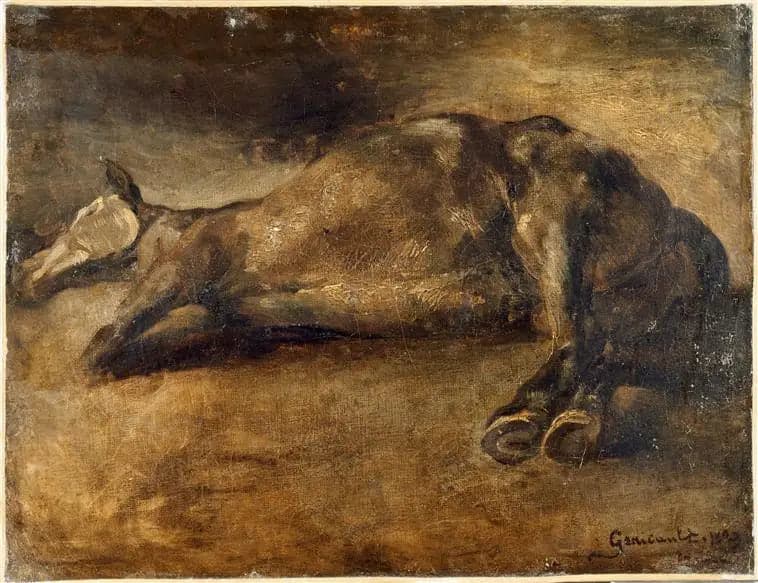
Dead Horse
- Original dimensions
- 36.5 x 28 cm
- Museum
- Bonnat-Helleu Museum
- Year
- 1823
Scene depicted
This painting immerses us in a poignant moment of reflection. Géricault, fascinated by death and decline, immortalizes a deceased horse, revealing a morbid beauty. The artist explores the fragility of life and its inevitable decline, confronting us with our own humanity. Every detail, every nuance of his pictorial intervention invites us to contemplate life and death.
Historical context
Created in 1823, at the crossroads of romantic art, Dead Horse showcases the visionary talent of Théodore Géricault . This iconic canvas , currently displayed at the Bonnat-Helleu Museum, is set in a time of artistic upheaval in Paris, where melancholy and emotion take precedence over classicism. The painting measures 36.5 x 28 cm, revealing the meticulousness of a work of art rich in heritage.
Place in the artist's career
Dead Horse represents a major milestone in Géricault's career, an artist whose journey is marked by stylistic revolutions. Anticipating the heights of romanticism , this painting stands alongside works such as The Raft of the Medusa and The Horse Race , signaling an intensification and maturation of his pictorial approach.
Anecdote
“Art must feel before it is seen.” This quote perfectly encapsulates the inspiration that permeates the creation of this masterpiece . Imagine a misty morning, in a silent stable, where the whisper of nature mingles with the scent of fresh hay. It is here that Géricault finds the spark that ignites the evocative power of his painting .