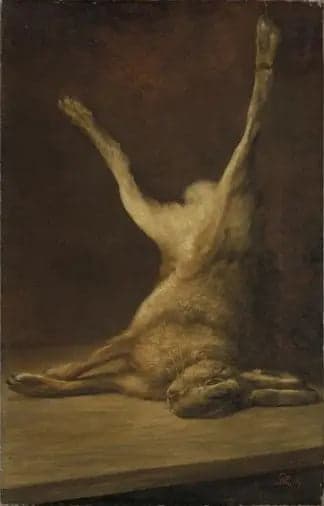
Dead Hare
- Original dimensions
- 51 x 80 cm
- Museum
- The Hague Museum of Art
- Year
- 1891
Scene depicted
The painting "Dead Hare" represents a hare, both delicate and tragic, in a natural setting. The composition is marked by meticulous attention to detail, capturing the fragility of life in the face of nature. Mondrian manages to express through this scene a contemplation of ephemeral beauty. The painting thus becomes a reflection on the natural cycle of life and death.
Historical context
Year: 1891 |BRK| Museum: The Hague Museum of Art |BRK| Dimensions: 51 x 80 cm
Place in the artist's career
This pictorial work , reflecting Mondrian's early curiosity, is positioned at the beginnings of his career, a moment when he is still in search of his artistic language. Alongside other notable paintings such as "Landscape" and "Tree" from the same period, "Dead Hare" reveals his technical and emotional evolution, a penchant for form and rhythm as painting becomes abstraction.
Anecdote
"Nature is my inspiration, yet it transforms through my gaze." It is with this conviction that Mondrian becomes enthusiastic about painting during a gentle spring morning, observing the wild species, the raw emotion of a hare in the daylight. This moment becomes the source of a pictorial work that he carefully shaped, which later resonates with vehement intensity.