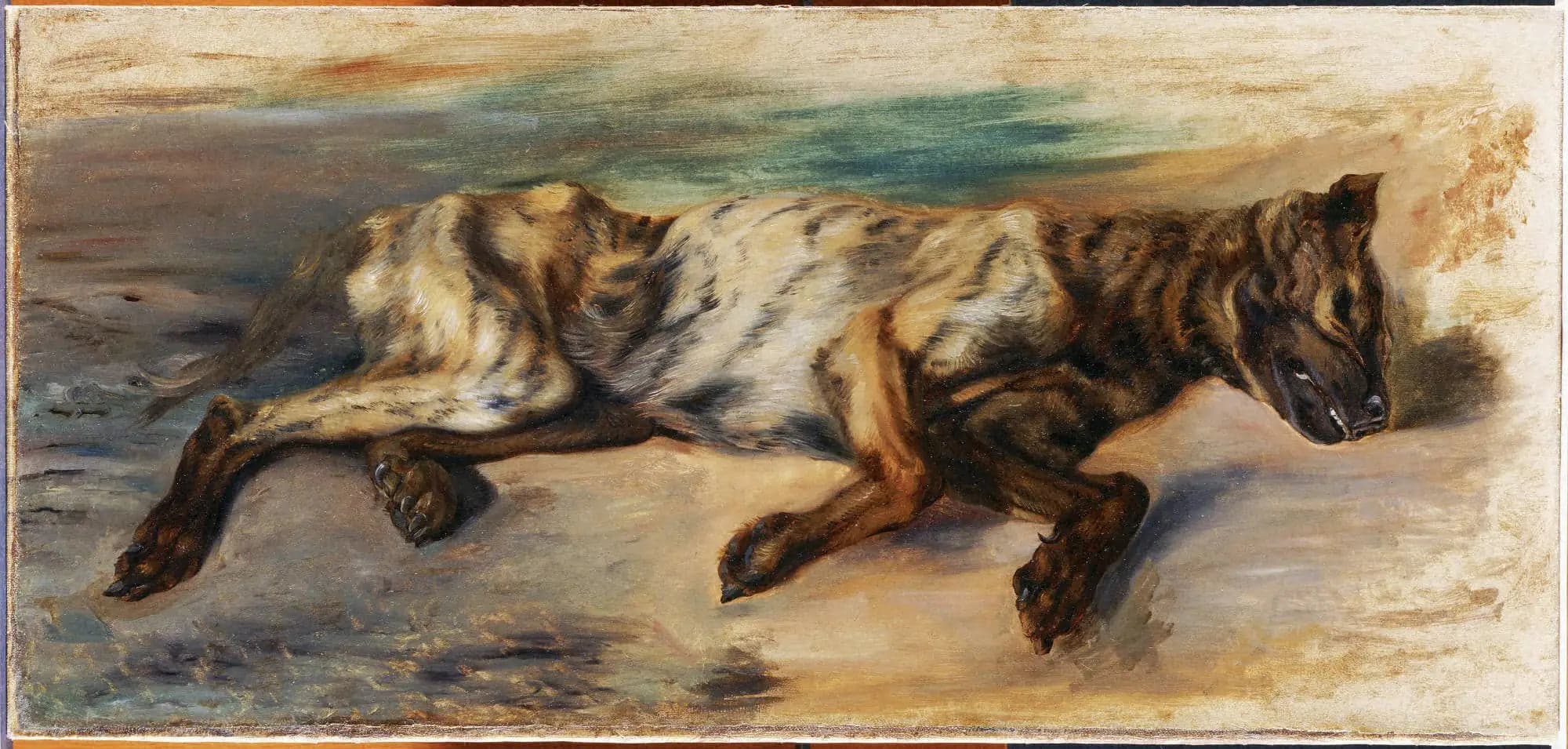
Dead Dog
- Original dimensions
- 87.5 x 41.5 cm
- Museum
- Princeton University Art Museum
- Year
- 1830
Scene depicted
The canvas Dead Dog depicts a lifeless animal, inert on the ground, a poignant image that reveals a raw reality. This painting illustrates not only the beauty of a decaying body in a natural environment but also a reflection on mortality and the ephemeral existence of living beings. Through this gaze, Delacroix succeeds in capturing the essence of life and death in a unique pictorial work .
Historical context
Artwork: Dead Dog |BRK| Artist: Eugène Delacroix |BRK| Year: 1830 |BRK| Museum: Princeton University Art Museum |BRK| Dimensions: 87.5 x 41.5 cm |BRK|
Place in the artist's career
Dead Dog represents a pivotal moment in Eugène Delacroix's career, marking an evolution towards darker and more introspective themes. Alongside his famous painting Liberty Leading the People and his renowned Dante and Virgil in Hell, Dead Dog illustrates his growing mastery in expressing tragic emotions and his ability to capture human essence in critical moments.
Anecdote
“Nature speaks to me only through its shadows, its pains, and its embodied mystery.” This fictional yet inspiring quote from Eugène Delacroix transports us to the time when he conceived his masterpiece . Imagine a late spring morning in Paris, where the lights dance on the wet cobblestones, and a simple fine cloak of soothing silence covers the city. It is in this setting that the painting Dead Dog is born, a blend of sweetness and nostalgia.