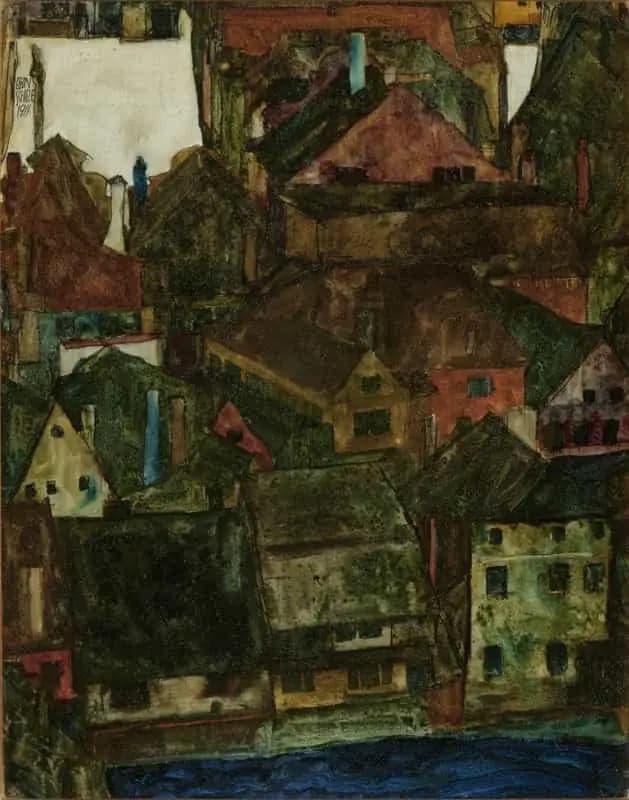
Dead City
- Original dimensions
- 29.3 x 37 cm
- Museum
- Veletržní palác
- Year
- 1911
Scene depicted
The composition of the painting "Dead City" captures the essence of a unique and melancholic urban life. The buildings, frozen in time, seem to whisper forgotten secrets, while a diffuse light permeates every corner of the pictorial work. Schiele manages, through his brushstrokes, to convey a sense of nostalgia, a disillusioned momentum that resonates with our sensitivity.
Historical context
Created in 1911, the painting emblematic "Dead City" was born in Vienna, a flagship city of the Austro-Hungarian Empire. This painting is deeply rooted in the artistic movement expressionist , which is characterized by its exploration of human emotions through bold forms and colors. Today, this canvas resides at the Veletržní palác , a museum that reflects the cultural effervescence of the region. With dimensions of 29.3 x 37 cm, this masterpiece invites the viewer to immerse themselves in a rich and disturbing universe.
Place in the artist's career
This masterpiece is situated at a turning point in Schiele's career, marking a period of maturity where his style fully asserts itself. "Dead City" precedes other major works, such as "The Waitress" and "Self-Portrait with an Arm in a Sling", illustrating a technical evolution towards an increasingly bold treatment of human emotions and lines.
Anecdote
"The city is a mirror of our souls. Every facet, every shadow carries a story." These words resonate like an echo of the genesis of this painting , inspired by a walk through the silent alleys of Vienna, where Schiele stopped one spring morning to contemplate the fleeting beauty of urban life. It is this breath of life that nourishes the evocative power of "Dead City".