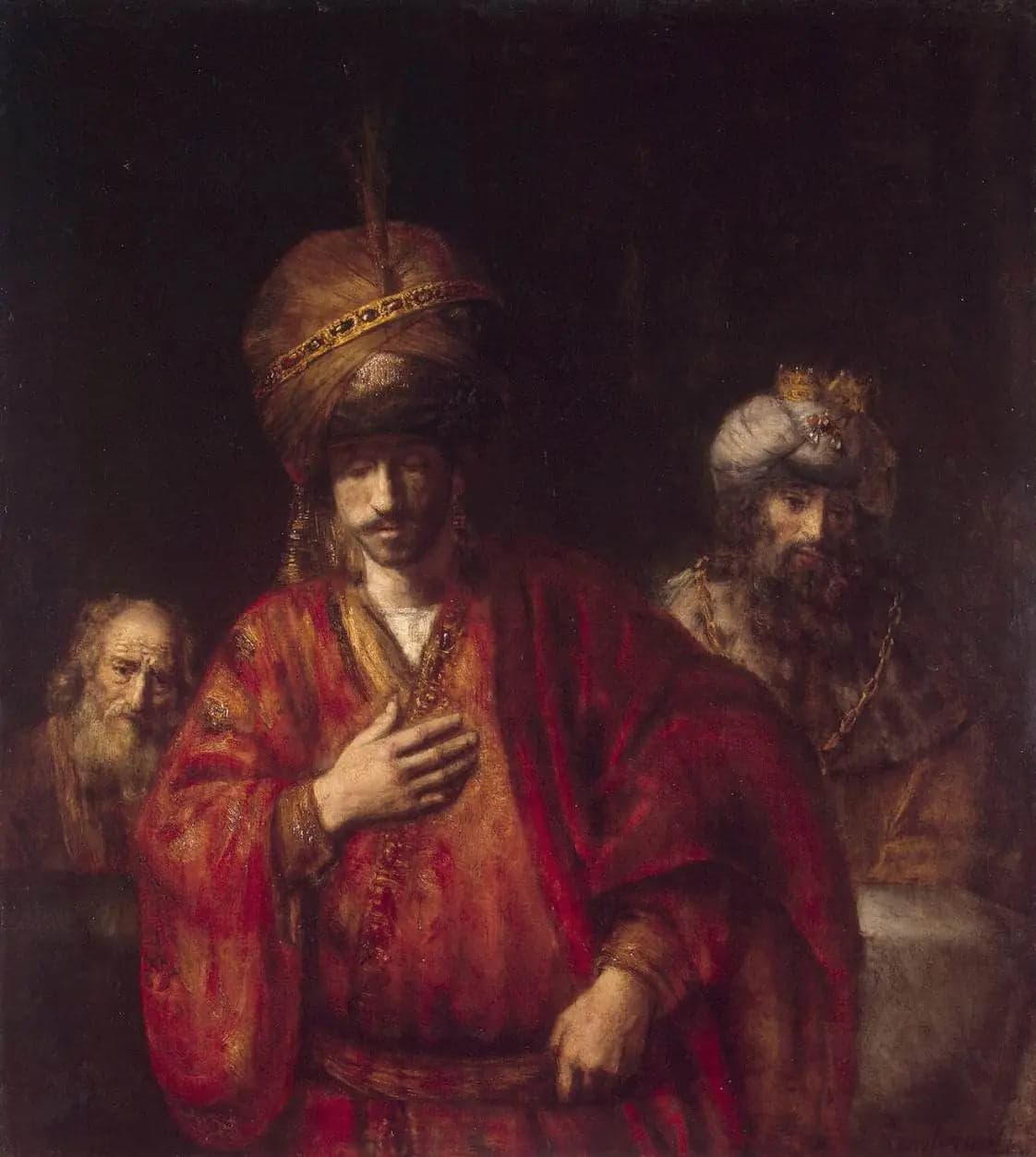
David and Uriah
- Original dimensions
- 116 x 127 cm
- Movement
- Dutch Golden Age painting
- Museum
- Hermitage Museum
- Year
- 1650
Scene depicted
In this painting – a true pictorial work – Rembrandt transports us to a vibrant and dramatic scene. King David, powerful and reflective, faces Uriah, subjecting the viewer to palpable tension. The play of shadows and light symbolizes not only the duality of humanity but also the confrontation between power and justice, a major theme in the artist's work.
Historical context
The painting not to be missed titled David and Uriah came to life in 1650, when Rembrandt unleashed his creative genius in the Netherlands at the heart of the Dutch Golden Age of painting. This masterful painting is currently on display at the Hermitage Museum , a sanctuary of art, where it enlightens visitors with its emotional depth. Measuring 116 x 127 cm, this canvas showcases the excellence of the era while conveying the cultural richness of past centuries.
Place in the artist's career
David and Uriah represents a turning point in Rembrandt 's career, a masterpiece that fits into a period of maturity in his art. Alongside The Night Watch and The Return of the Prodigal Son , this painting illustrates a technical evolution as well as an increased emotional depth, confirming his status as a master of light and shadow.
Anecdote
“Light is the essence of life,” Rembrandt might have said while painting this masterpiece. Imagine him working in his studio, bathed in the light of a spring morning, where he locks eyes with a model, inspiring the vibrant emotions found in David and Uriah . This painting is not just a narrative; it evokes an inner world, a deep human connection.