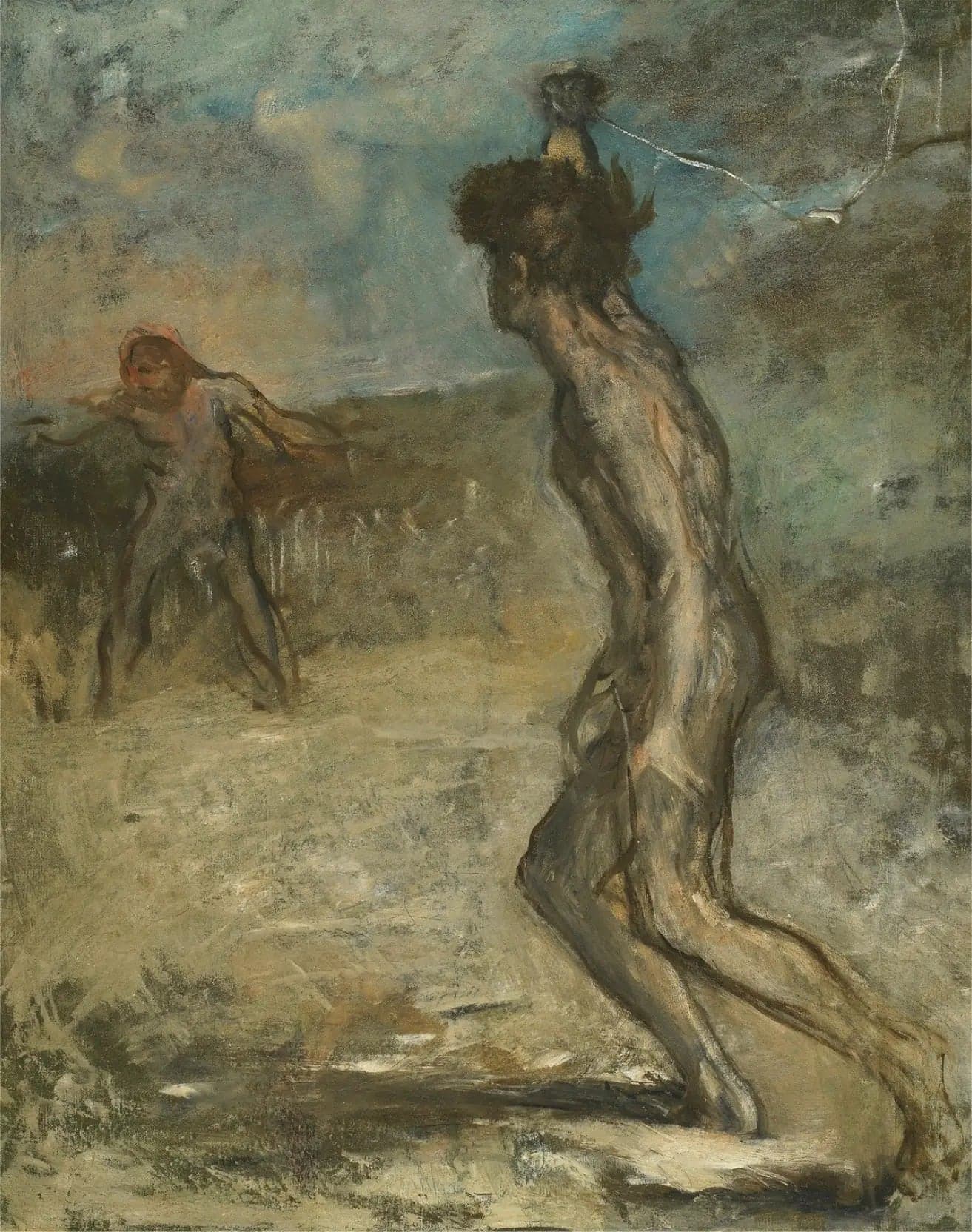
David and Goliath
- Original dimensions
- 63.8 x 80 cm
- Museum
- Fitzwilliam Museum
- Year
- 1864
Scene depicted
The painting "David and Goliath" depicts the famous biblical confrontation between the innocent bravery of David and the intimidating power of Goliath. In a timeless context, Degas reinterprets this struggle, capturing not only the despair of a giant about to fall but also the determination of his opponent. The gazes, the postures, everything in this painting exudes a rare dramatic intensity.
Historical context
Created in 1864, this painting finds its origin in the vibrant artistic milieu of Paris, an iconic city of the Impressionist movement. At that time, France experienced a significant influx of innovative currents, both aesthetically and culturally. Today, this canvas is preserved within the prestigious Fitzwilliam Museum , a true sanctuary for art lovers in Cambridge, England.
Place in the artist's career
This canvas is situated at a pivotal moment in the career of Edgar Degas , revealing his new and bold style while flattering the real conventions of realism . It can be paralleled with his other paintings , such as "The Dance Class" and "The Dancers at Rest," which also illustrate dynamic compositions and an innovative exploration of forms and movements.
Anecdote
Edgar Degas reportedly stated on a sunny morning: "The true essence of art lies in the ability to capture the moment." It is in this irrepressible quest that he painted the masterpiece that is David and Goliath, inspired by ancient legends and a golden light making its way through the leaves of the trees near his studio.