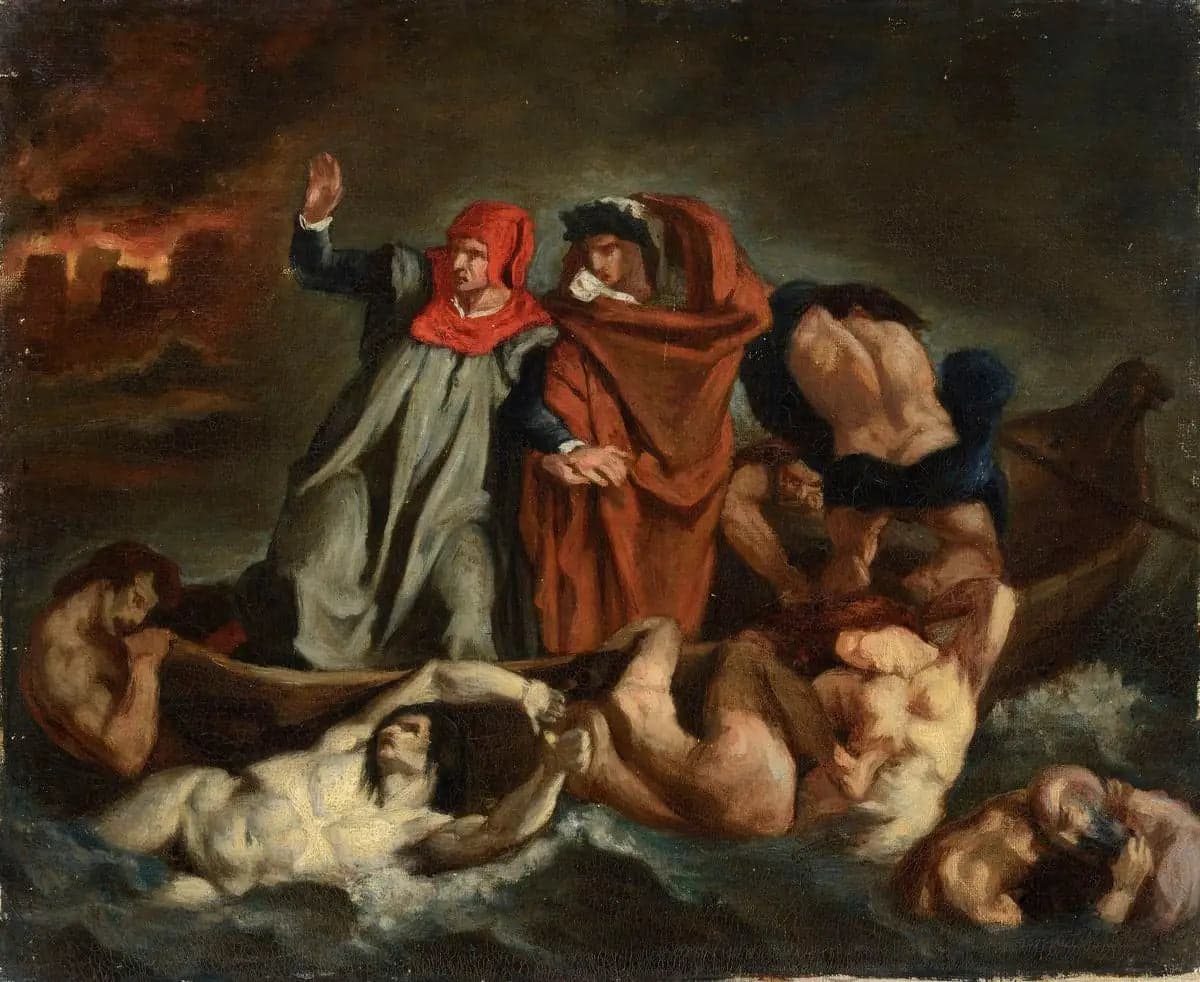
Dante's Boat
- Original dimensions
- 41 x 33 cm
- Museum
- Metropolitan Museum of Art
- Year
- 1859
Scene depicted
This painting, inspired by the first circle of hell from Dante Alighieri, illustrates the tragic moment of the boat crossing the river, a symbolic passage between the world of the living and that of the dead. Manet, with his painting , conveys a dramatic intensity with each stroke, revealing a struggle between light and darkness.
Historical context
Created in 1859, this painting is now housed at the Metropolitan Museum of Art in New York. The depicted scene is part of the Impressionist movement, reflecting a time when artists sought to represent light and its effects on nature. The canvas carries the cultural heritage of 19th century Paris, a crossroads of creativity and artistic innovations.
Place in the artist's career
The Boat of Dante marks a starting point in Manet's artistic evolution, a masterpiece that precedes other major works such as The Luncheon on the Grass and Olympia. Each of these canvases reflects his bold stylistic exploration, blending Impressionism and Realism .
Anecdote
Édouard Manet reportedly said: “Every brushstroke is a conversation with the world.” Inspired by a sunny morning near the Seine, it is there that he captured the essence of the composition of The Boat of Dante, evoking the scents of a budding spring and the gentle whispers of water.