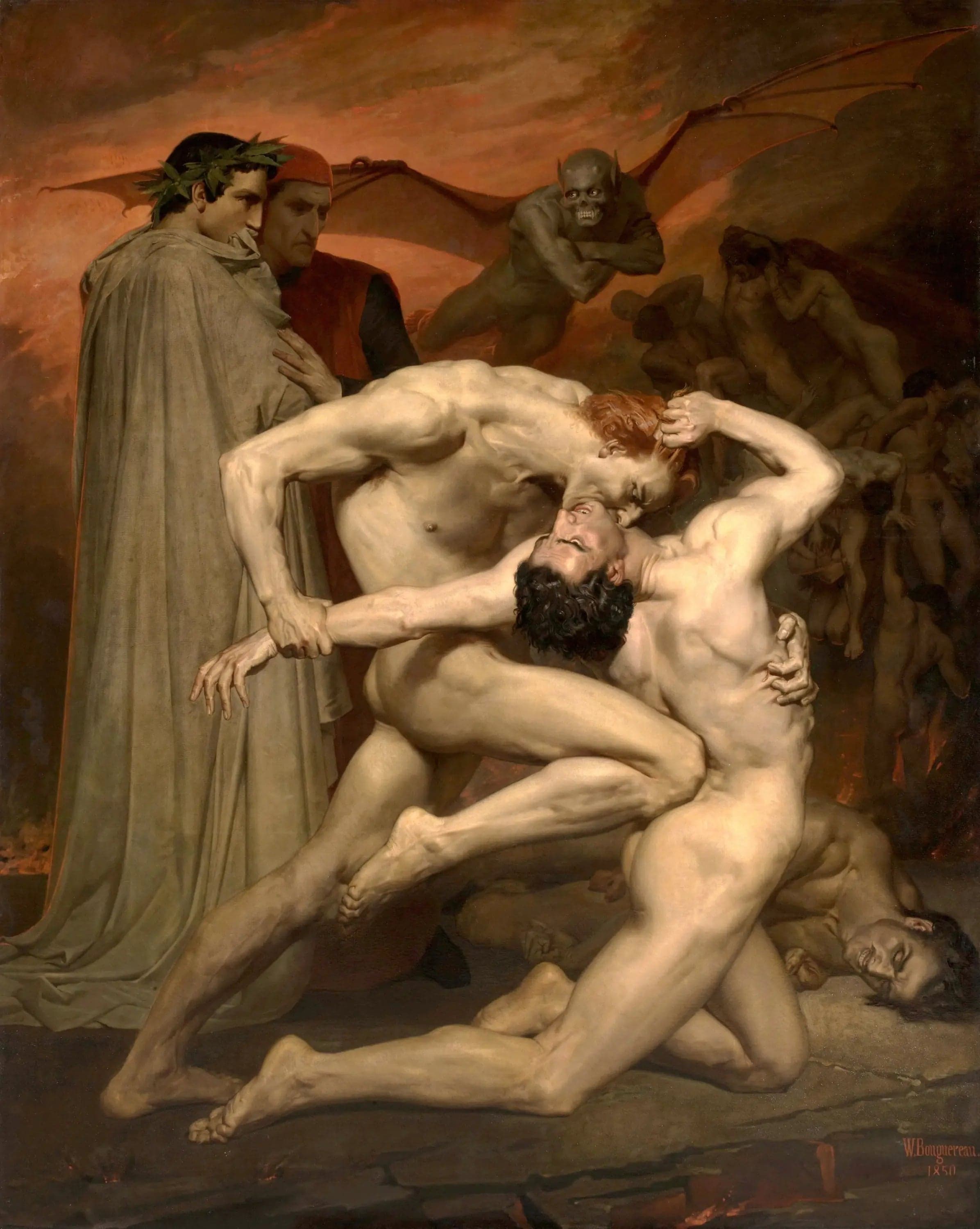
Dante and Virgil in Hell
- Original dimensions
- 225.3 x 280.5 cm
- Movement
- Academicism
- Museum
- Orsay Museum
- Year
- 1850
Scene depicted
Through Dante and Virgil in Hell , Bouguereau immerses us in the troubling universe of infernity. Dante, accompanied by his guide Virgil, traverses a chaotic landscape that is both terrifying and captivating, where each suffering soul calls to us with its desperate expression. The scene is a living tableau of contradictory emotions, light and darkness, reminding us of the human condition in all its complexity.
Historical context
Iconic work of 19th century academicism , Dante and Virgil in Hell was created in 1850 in the vibrant artistic atmosphere of Paris. At the heart of an environment where art intertwines with intellectual debates, this painting draws its inspiration from Dante Alighieri's Divine Comedy, thus elevating a Dantesque scene to the level of a masterpiece . Today, this canvas is preserved at the Orsay Museum , where its monumental dimensions of 225.3 x 280.5 cm command a presence.
Place in the artist's career
This canvas fits into Bouguereau's mature period, showcasing his skill in merging drama and beauty. In parallel, works like The Last Days of Pompeii and The Birth of Venus illustrate the evolution of his style, where painting technique refines and emotions intensify, paying tribute to his technical mastery.
Anecdote
William-Adolphe Bouguereau once declared: “The truth of feeling lies in the gaze.” That morning, under the light of a rising sun, he stumbled upon an old manuscript in a forgotten alley, thus generating the creative spark for this canvas . The emotion of this encounter is felt in every detail of the painting , where Dante and Virgil plunge into a hell of a thousand colors, a vibrant interpretation of human suffering.
Major exhibitions
Salon of 1850