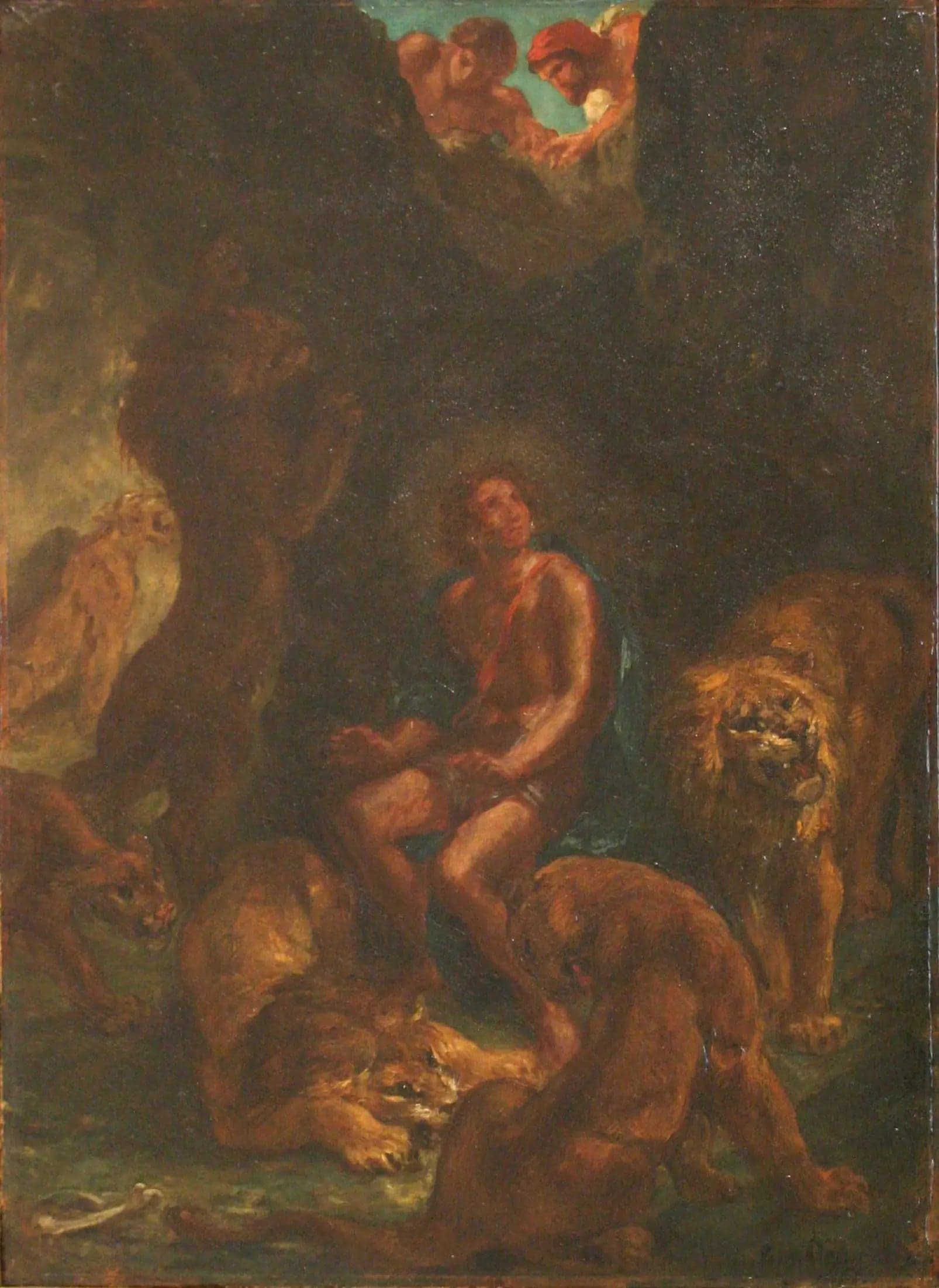
Daniel in the Lion's Den
- Original dimensions
- 49.5 x 66.5 cm
- Museum
- Fabre Museum
- Year
- 1849
Scene depicted
“Daniel in the Lion's Den” depicts a dramatic and tense moment, where the protagonist, unwavering in his faith, faces a pack of threatening lions. The strength of this scene lies in Daniel's calm assurance, revealing the struggle between man and fear, a powerful symbol of spiritual resistance in the face of adversity.
Historical context
Created in 1849, this painting finds its roots in Montpellier, France. It belongs to the romantic movement, a current that celebrates emotion and the grandeur of ancient tales. Through this canvas , Eugène Delacroix immerses us not only in the richness of an era but also in the fervor of a spiritual quest. The painting is currently displayed at the Fabre Museum , a laboratory of cultural excellence, where its impeccable dimensions do not detract from the power of its narrative.
Place in the artist's career
This painting marks a major turning point in Delacroix's career, reflecting his shift towards a bolder and more expressive style. Alongside “ Liberty Leading the People ” and “The Massacres of Scio ,” one can observe a fascinating evolution both technologically and emotionally. “Daniel in the Lion's Den” thus stands as a crucial step in the artist's mastery of composition and color.
Anecdote
“Beauty is a simple emotion transformed into painting ,” might have said Eugène Delacroix on a sunny morning, as he contemplated the changing reflections of colors on his palette. Inspired by faith and strength, the artist brought this pictorial work to life in a space filled with soft light, where each brushstroke seemed to whisper forgotten secrets. The evocative power of this canvas lies in its aspiration to capture moments of eternity.