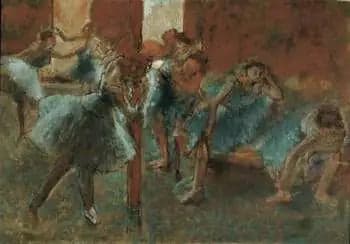
Dancers in Rehearsal
- Original dimensions
- 100.5 x 70.5 cm
- Museum
- Von-der-Heydt Museum
- Year
- 1896
Scene depicted
This painting illustrates a vibrant scene from the daily life of dancers, capturing a moment of theatrical rehearsal. The composition reveals focused bodies, their elegant silhouettes contrasting with the muted decor of the room. Through this pictorial work, Degas immerses us in a universe where movement and emotion respond to each other, sketching the dreams and struggles of these dedicated artists.
Historical context
This iconic painting was created at the end of the 19th century in Paris, as part of the Impressionist movement that revolutionized the art world. The painting is currently housed at the Von-der-Heydt Museum in Germany, a setting where Degas' legacy continues to resonate. Each brushstroke reflects the fusion of technique and artistic vision from a vibrant era, marked by the emergence of Dancers, symbols of lightness and grace.
Place in the artist's career
The canvas “Dancers in Rehearsal” is at the heart of Degas' career, reflecting his unwavering exploration of dance and movement. As he establishes himself as a pioneer of Impressionism , a line can also be drawn between this painting, his famous “Dancers at the Barre” and “The Dance Class,” illustrating both a technical and emotional evolution over time, from innocence to artistic maturity.
Anecdote
Edgar Degas once stated: “Art is a serious pastime.” Imagine a spring morning in Paris, the silence of a studio where the artist observes his models, their delicate bodies moving with fluid harmony. It is in this intimate setting that the evocative power of this canvas is born, a masterpiece whose emotion shines with every return of a gesture.