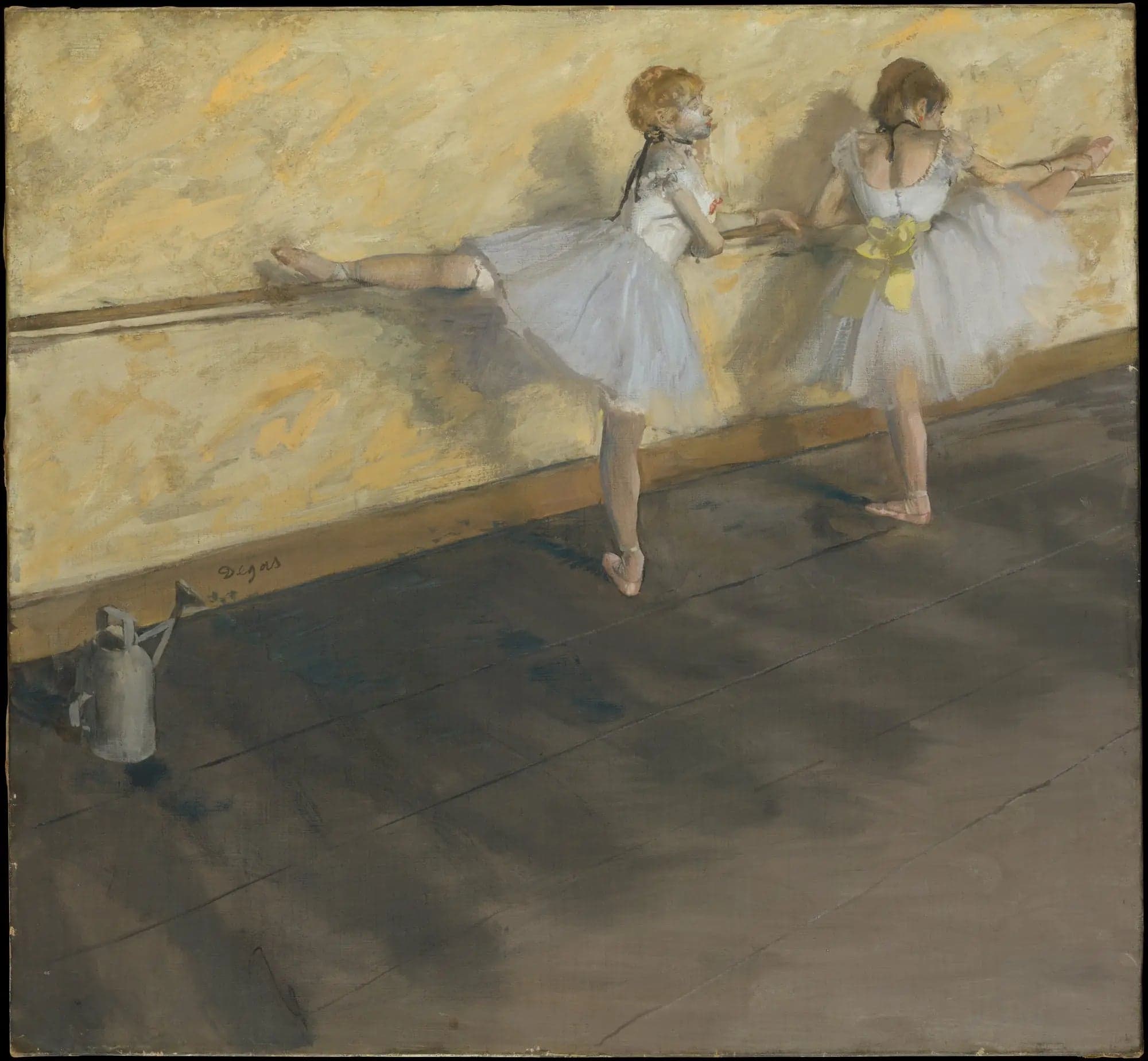
Dancers at the Bar
- Original dimensions
- 97.79 x 130.175 cm
- Museum
- Phillips Collection
- Year
- 1900
Scene depicted
In this pictorial work , Degas finely depicts a familiar scene from dance studios. The figures of the dancers, focused and elegant, practice at the barre, their gaze turned towards their teachers. The composition highlights the technique and ardor of the budding artists, capturing a rare intimacy, while playing with the lights and shadows that dance on the floor, making visible, almost palpable, the effort and passion of the subjects represented.
Historical context
Created in 1900, this painting evokes the artistic Paris of the Belle Époque, a golden age where culture shines brightly. Edgar Degas , a leading figure of the Impressionist movement, signs here a work that captures the beauty of ballet, a symbol of grace and discipline. Currently exhibited at the Phillips Collection in Washington, this monumental canvas of 97.79 x 130.175 cm becomes a window into a world aspiring to aesthetics.
Place in the artist's career
“Dancers at the Barre” represents a turning point in Degas's career, establishing his perfectionism and attention to movement at the heart of his production. Compared to other paintings such as “The Dance Class” and “Dance at the Moulin de la Galette,” it embodies a period of maturity, where the artist merges his sympathy for ballet with an increasingly refined technique.
Anecdote
“Dance is an art, but it is above all a state of mind.” This quote could illustrate Degas's fervent desire to capture the very essence of his models. Imagine the artist, one spring morning, waiting in the shadows of a dance studio, observing with fascination the graceful movements of the dancers at the barre. It is this painting, an expression of that fleeting moment, that vibrates with emotions and humanity.