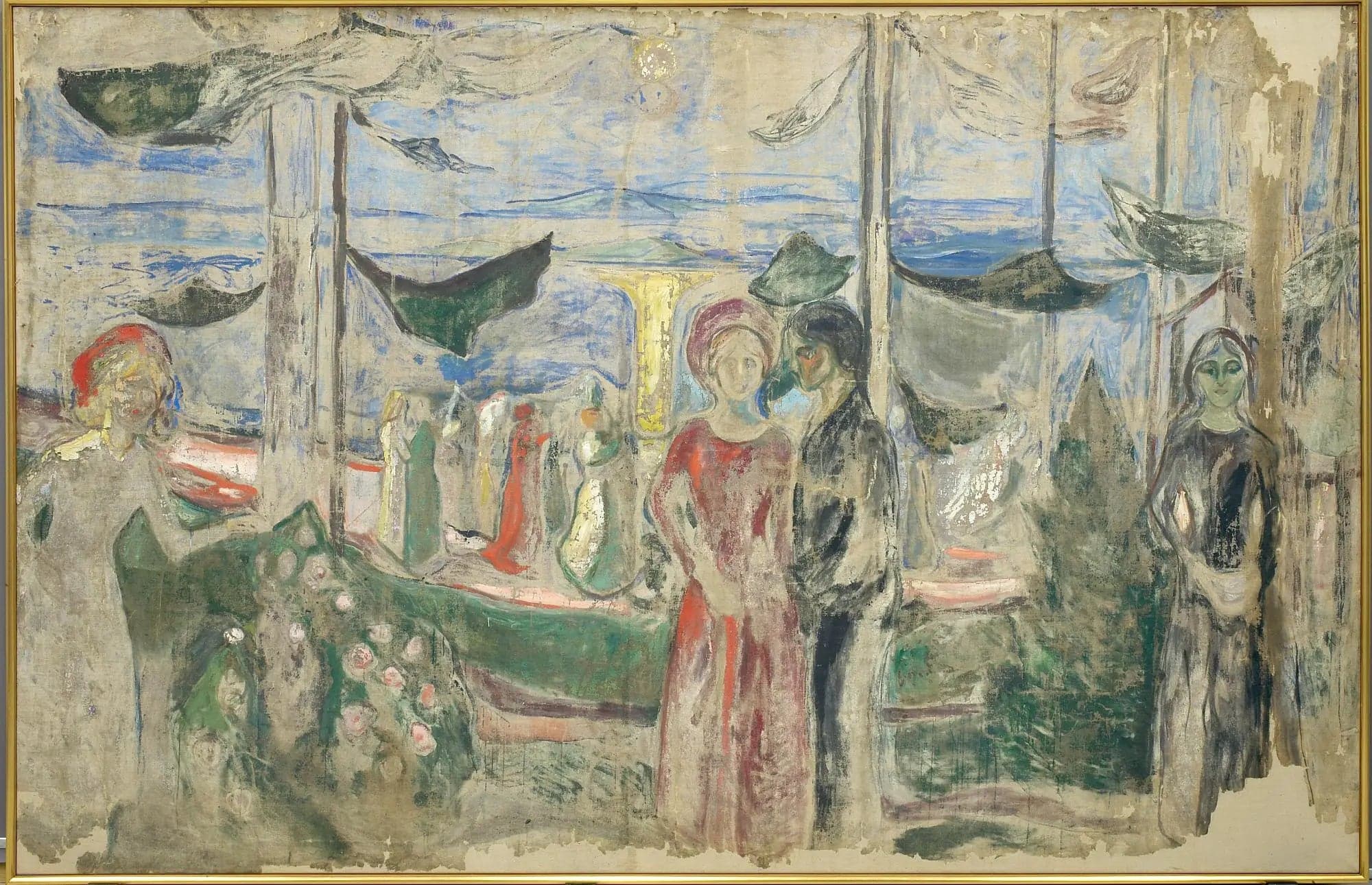
Dance on the Beach
- Original dimensions
- 311 x 200.5 cm
- Museum
- Munch Museum
- Year
- 1921
Scene depicted
The painting “Dance on the Beach” depicts a magical scene of a beach animated by couples swirling in a joyful ballet, embodying the freedom and lightness of a Norwegian summer. The opalescent waves of the sea meet at the horizon, while the bright light makes the shadows of the figures dance. Every detail testifies to a festive atmosphere, where nature becomes the theater of dreams and emotions.
Historical context
Created in 1921, in the intimate setting of Oslo, the capital of Norway, this painting is part of the expressionist movement, a radical artistic current imbued with intense emotions. Munch, influenced by the turmoil of his time, captures a fleeting moment by the sea, where dance and joy blend with a deep sensitivity. Today, this canvas proudly resides in the Munch Museum, testifying to the artist's legacy and fascinating those who come to admire his genius. The spectacular dimensions of the work, 311 x 200.5 cm, amplify its visual impact.
Place in the artist's career
“Dance on the Beach” occurs at an artistic turning point in Munch's career, where he further merges his emotional style with a more optimistic approach. Compared to earlier works like “The Scream” and “The Madonna,” there is an evolution towards lightness and celebration of life. This canvas thus represents a stylistic peak, while revealing the diversity of his pictorial universe.
Anecdote
“Dance is not just a movement, it is the expression of the soul.” Edvard Munch is said to have uttered these words one sunny morning on the shores of Oslo. Inspired by the beauty of bodies in motion, he imagined capturing the very essence of human ecstasy. This emotion comes to life in Dance on the Beach , a canvas where each brushstroke evokes the joy of bathers in harmony with nature.