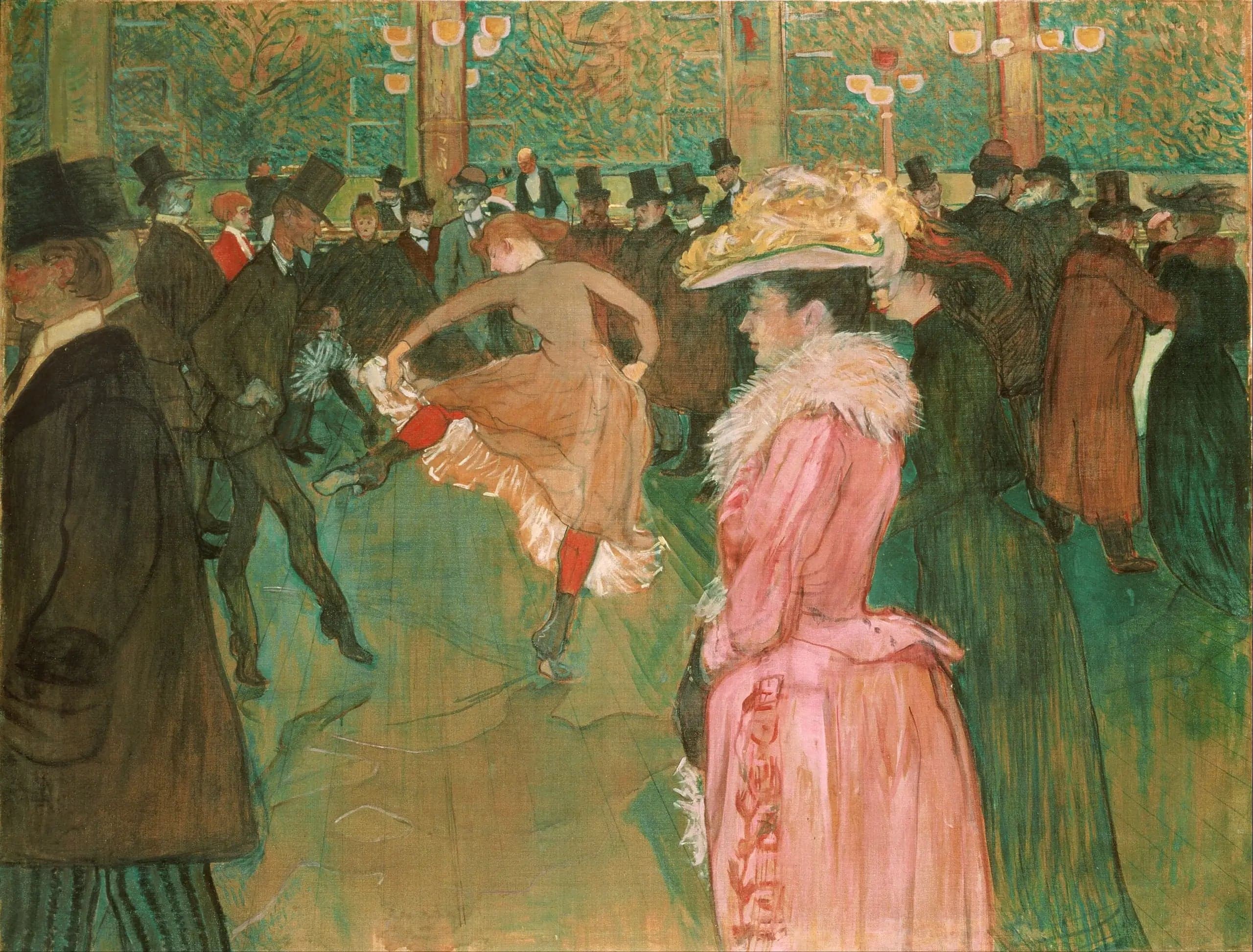
Dance at the Moulin-Rouge - Henri de Toulouse
- Original dimensions
- 316 x 298 cm
- Museum
- Musée d'Orsay
- Year
- 1895
Scene depicted
In this masterpiece, dance becomes a celebration, a communion between artists and spectators, mingling in an electric atmosphere. The painting depicts dancers and spectators in the midst of a lively hall, where the dim light creates a play of shadows and lights, giving each character an imminent life. Every detail, from the movement of skirts to expressive faces, captivates and transports the observer into the carnal and playful universe of the Moulin-Rouge.
Historical context
Created in 1895, this painting emblematic of Toulouse-Lautrec embodies the Parisian effervescence at the end of the 19th century. Located in the heart of the famous Montmartre district, this pictorial work is part of the post-impressionism movement, brilliantly capturing the festive and vibrant atmosphere of the Belle Époque. The canvas is now housed in the Musée d'Orsay, a showcase that celebrates the artistic heritage of its time, revealing the beauty and creativity of a Paris in full effervescence.
Place in the artist's career
The Dance at the Moulin-Rouge is a highlight of Toulouse-Lautrec's career, representing the quintessence of his bold style. Associated with his other iconic paintings like “The Café Concert” and “The Singer”, this painting illustrates the evolution of his art, from the portraitist's gaze on human intimacy to the capture of collective energy.
Anecdote
“Life is dance. Dance is the soul.” These words resonate like an echo of Toulouse-Lautrec's memories, marked by the fiery evenings at the Moulin-Rouge. Imagine him, on a warm summer evening, soaking in the rhythms and laughter of the stage, his canvas before him, vibrant with colors and movements.
Major exhibitions
Autumn Salon of 1904