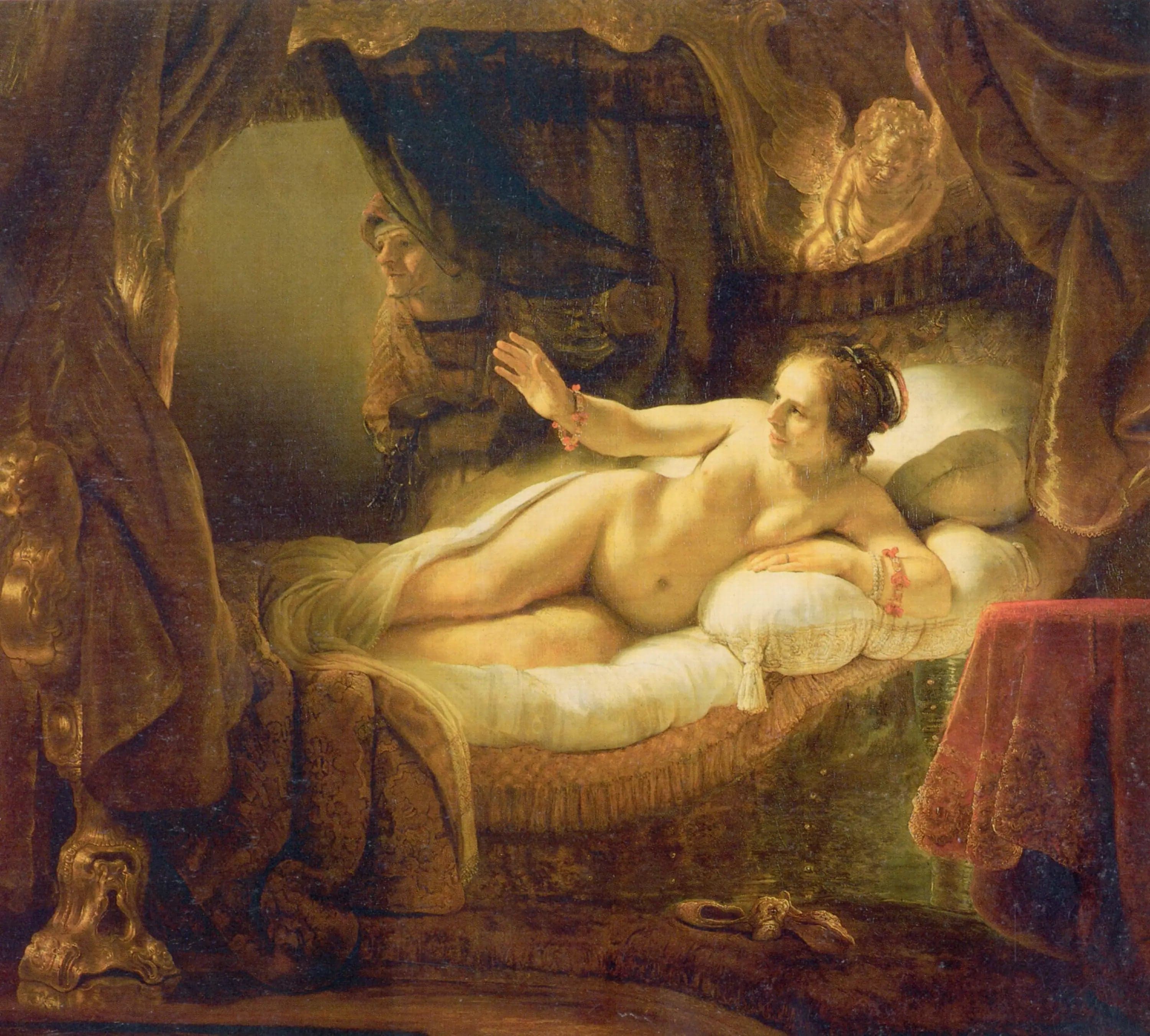
Danaë
- Original dimensions
- 202.5 x 185 cm
- Movement
- Dutch Golden Age of Painting
- Museum
- Hermitage Museum
- Year
- 1636
Scene depicted
The canvas illustrates a powerful mythological moment. Danaë, wrapped in delicate drapery, receives the golden light of Zeus, symbolizing both desire and fertility. The light, masterfully used, illuminates her serene and revealing face, while the background fades into suggestive shadows that intensify the intimacy of the scene.
Historical context
Created in 1636 in the heart of the Netherlands, this iconic painting is set in the midst of the flourishing period of the Dutch Golden Age of Painting. The work, Danaë , is today carefully preserved at the Hermitage Museum , a true cathedral of art. Its majestic dimensions, 202.5 x 185 cm, immediately capture the gaze and imagination.
Place in the artist's career
Danaë represents a turning point in Rembrandt's career, anchoring his status among timeless masters. Compared to The Night Watch and Self-Portrait with Fur Hat , this painting marks a technical evolution in the manipulation of light and emotion. Each brushstroke is thoughtful, each nuance is calculated, revealing an artistic maturity unmatched at that time.
Anecdote
“Art is a light in the darkness of existence.” These words from Rembrandt resonate in the intimacy of the painting Danaë , evoking a golden morning when the artist, inspired by a ray of sunlight warming the space, translated his timeless vision onto the canvas. He let himself be carried away by emotion, merging his passion with his genius.