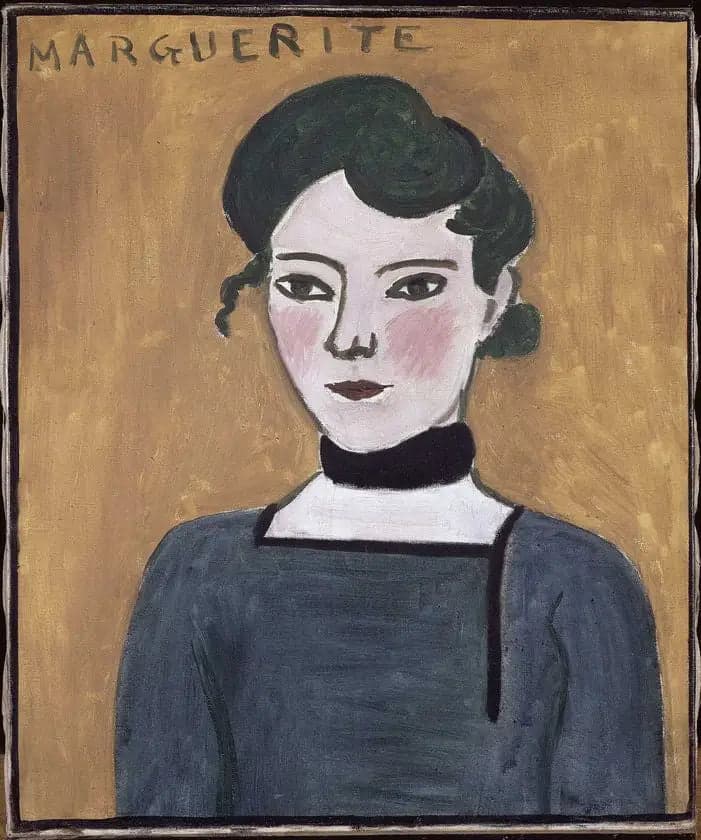
Daisy
- Original dimensions
- 54 x 65.1 cm
- Museum
- national Picasso museum - Paris
- Year
- 1907
Scene depicted
"Marguerite" reveals a flamboyant bouquet of flowers in a vase, enveloped in a dreamy and warm atmosphere. The bold composition vibrates with each color, offering a modern interpretation of simple yet dazzling nature, capturing the duality between grace and spontaneity. Through this painting, Matisse immerses us in a world of beauty that is both immediate and sublime.
Historical context
Created in 1907, the painting "Marguerite" is the vibrant reflection of the Fauvist period, where Henri Matisse redefined the boundaries of color and form. Paris, at that time, was bubbling with innovative ideas and artistic effervescence, a true fertile ground for the emergence of this masterpiece. Currently, this canvas reigns at the national Picasso museum, a sanctuary of modern art, where it invites us to dive into the depth of its expression. With its imposing dimensions of 54 x 65.1 cm, this canvas attracts the eye and captivates the soul.
Place in the artist's career
Throughout his career, Matisse evolved towards increasingly bold styles, and "Marguerite" represents a key milestone. Alongside "The Dance" and "The Joy of Life," this masterpiece illustrates his transition from a symbolist approach to a total liberation of colors and forms, positioning Matisse as a pioneer of Fauvism .
Anecdote
Henri Matisse once stated: "Color must be a feeling, not just a simple choice of tone." In this painting , he captures the essence of a spring morning, when the soft light filters through the trembling leaves, creating a sensory spectacle. The inspiration is said to have come from a walk in a secret garden, where the wild beauty of the flowers whispered sweet secrets to him.