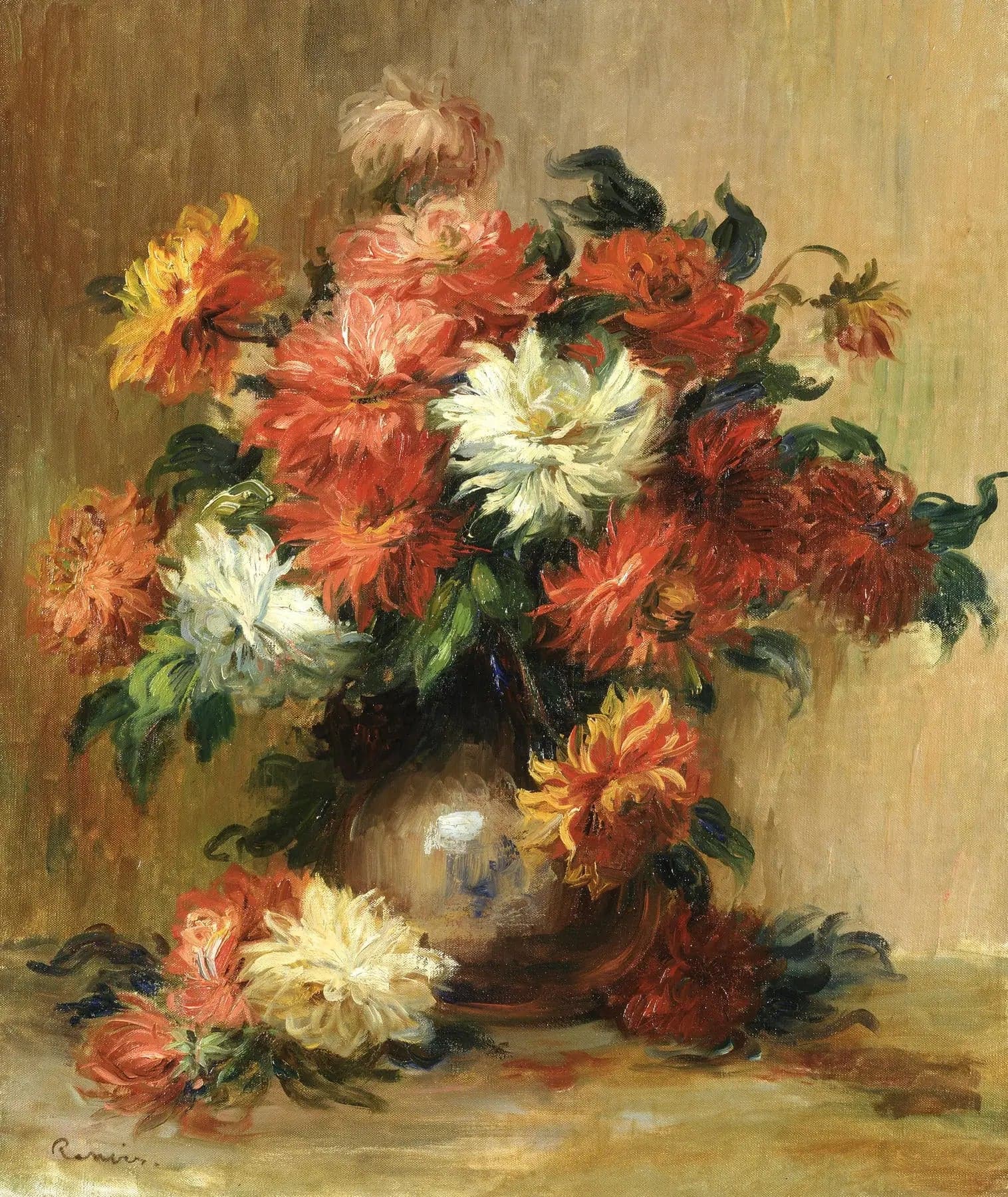
Dahlias - Pierre
- Original dimensions
- 54 x 65 cm
- Museum
- Emil G. Bührle Foundation and Collection
- Year
- 1887
Scene depicted
The painting "Dahlias" is a celebration of flowers, where each petal, carefully shaped, seems to vibrate under the light. Renoir chooses to capture the richness of dahlias, these summer flowers, in a harmonious composition that evokes both sweetness and brilliance. The work reveals a serene atmosphere, where nature is capitalized, revealing the artist's passion for scenes of everyday life.
Historical context
Created in 1887, the painting "Dahlias" is set in the idyllic framework of the Belle Époque, in Paris, the city of light, a stronghold of Impressionism . This canvas , exhibited at the Emil G. Bührle Foundation and Collection , illustrates the artistic movement that advocated a new vision of light and colors. Renoir, through this pictorial work , captures the essence of an era full of vitality and expressiveness.
Place in the artist's career
"Dahlias" is situated at a pivotal moment in Renoir's career, where he sharpens his style and approach to the canvas . This masterpiece is part of a masterful period after "Luncheon of the Boating Party" and before "The Bathers," marking a transition towards a deeper understanding of light and color. This painting testifies to a growing maturity in Renoir's art, thus becoming a major milestone in his artistic journey.
Anecdote
Renoir, speaking of his masterpiece , said: "Painting is for me a perfume that I cannot hold back; it must bloom." That morning, surrounded by vibrant dahlias in the garden, he captured the soft light of spring dancing on the petals, revealing a fleeting and poetic beauty in his canvas .