Cutting and Shaping of Wood
- Original dimensions
- 66 x 42 cm
- Museum
- Not specified
- Year
- 1902
Scene depicted
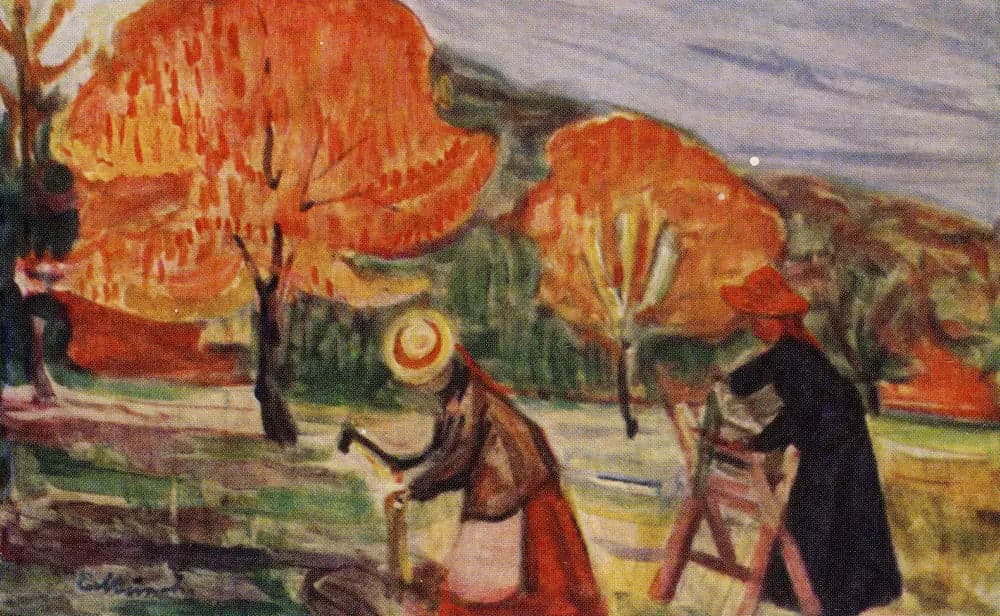
The painting “Woodcut and Woodworking” illustrates a group of lumberjacks in full action, focused on their task in an enchanting and immersive natural environment. Munch uses stylized silhouettes to suggest the struggle between man and nature, integrating elements of inner anxiety within an almost mythical landscape, which manifests as a living painting, vibrant with energy and tension.
Historical context
Created in 1902, this painting reflects an era marked by emotional tensions and the search for new forms of expression. Located in a rapidly changing Europe and nourished by the expressionist movement, Woodcut and Woodworking bears witness to the very essence of Edvard Munch 's art. Currently, the location of this canvas remains uncertain, adding to its mystery. Its dimensions, 66 x 42 cm, give this canvas an intimate presence.
Place in the artist's career
“Woodcut and Woodworking” marks a transition in Munch's career: after initial explorations of the human psyche, he here enters a more tangible representation of daily life. This painting stands alongside other major works like “The Scream” and “The Madonna,” showing an evolution in his style, where expressive tension becomes more palpable through a nuanced realism .
Anecdote
“Through the wood, I see the suffering and beauty of existence.” This quote summarizes the profound impact nature had on Munch. Inspired by a misty morning near the Norwegian forests, he virtuously captured human anxiety in the face of nature, attaching his feelings to his painting . The canvas thus becomes an echo not only of what he sees but of what he deeply feels.